The global commercial egg industry is experiencing the most profound infrastructural transformation in its modern history. Driven by evolving consumer preferences, corporate animal welfare pledges from major food retailers, and sweeping legislative mandates across North America and Europe, traditional battery cage housing is being systematically dismantled. In its place, producers are constructing sophisticated multi-tier aviary barns, expansive free-range facilities, and regenerative mobile pastured operations. While alternative housing dramatically improves avian behavioral expression, it introduces unprecedented management complexities in flock ethology, disease exposure, and environmental biosecurity.
Managing non-caged flocks requires farm operators to evolve from automated equipment monitors into keen observers of avian behavioral ecology. When thousands of hens are liberated to interact in open, three-dimensional social environments, instinctive behaviors—such as dust bathing, foraging, perching, and nesting—must be accommodated, while natural destructive behaviors—such as feather pecking, cannibalistic vent trauma, smothering, and floor laying—must be proactively managed through architectural design and precision husbandry.
🥚
Regulatory Standards
Classification and Regulatory Standards of Alternative Egg Systems
To evaluate these production models, one must clarify the exact regulatory and certification definitions governing commercial egg marketing:
1. Cage-Free Aviary Systems
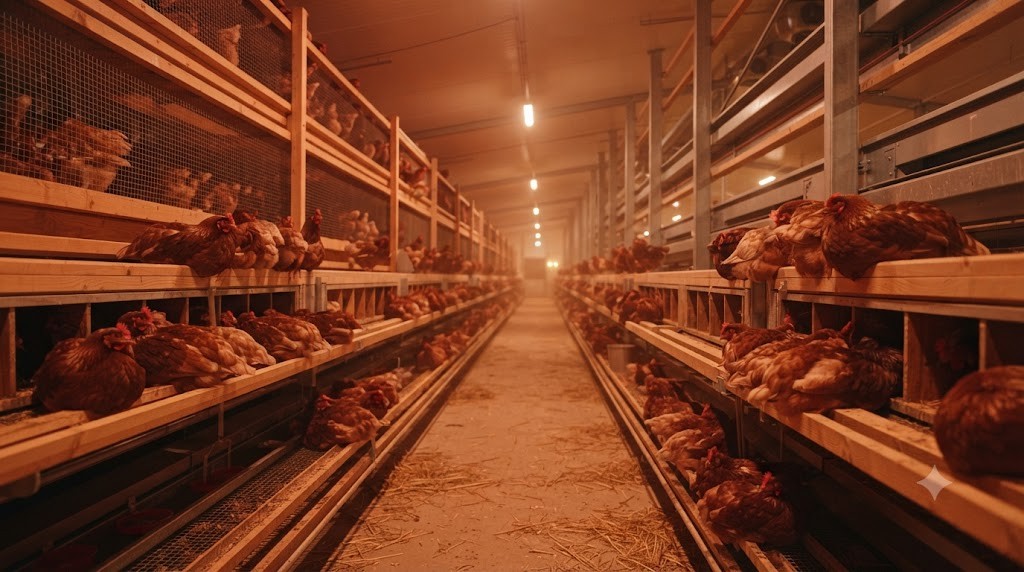
Under USDA, EU, and certified humane standards, ‘cage-free’ denotes birds housed entirely indoors within an enclosed barn without confinement in cages. Modern multi-tier aviaries utilize the vertical cubic space of the barn, featuring stacked wire tiers containing automated feeding chains, nipple drinkers, elevated perches, and private communal nest boxes. Hens can move freely between vertical tiers and descend to a ground-level litter floor bedded with wood shavings. Minimum space allowances typically mandate 1.0 to 1.5 square feet of usable floor area per hen, with at least 15 cm of perching space per bird.
2. Free-Range Production
Free-range systems build upon cage-free indoor standards by providing continuous daytime access to an outdoor area via automated pop-holes along the building walls. European Union regulations mandate outdoor stocking densities no greater than 2,500 hens per hectare (4 square meters per bird), while USDA standards require that birds have continuous outdoor access during daylight hours, though specific acreage densities are not federally codified unless verified through third-party humane audits.
3. Pastured (Pasture-Raised) Production
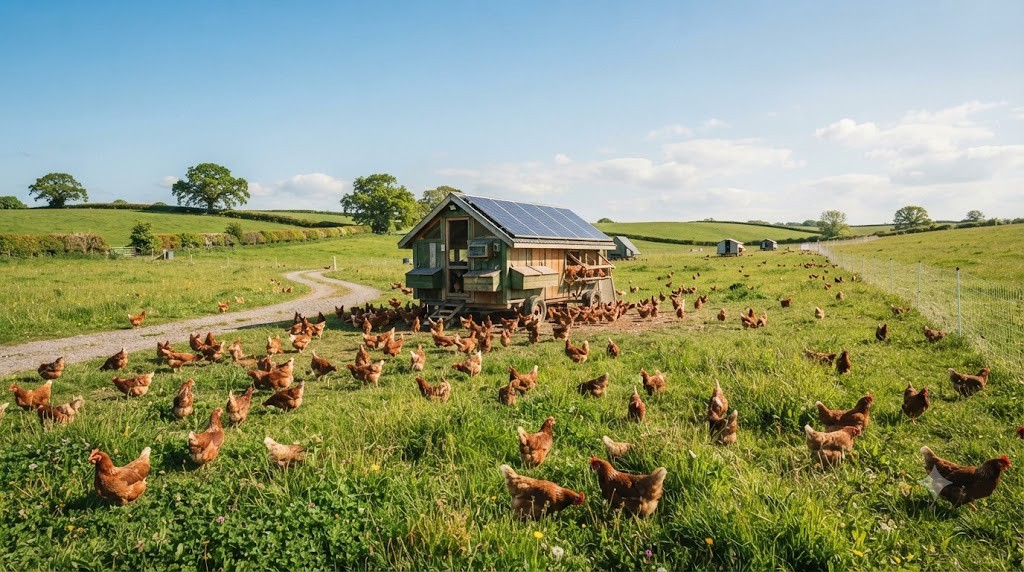
Representing the gold standard of outdoor production, pasture-raised standards (such as Certified Humane or Animal Welfare Approved) require a strict minimum of 108 square feet of pasture per bird (maximum 400 birds per acre). Pastured operations utilize portable mobile housing coops moved regularly across managed rotational grazing paddocks, ensuring that the outdoor sward remains vegetated with diverse grasses and legumes rather than denuded into barren mud.
| Production System | Indoor Space / Bird | Outdoor Access | Minimum Outdoor Area | Capital Cost / Bird | Primary Welfare Advantage | Primary Management Risk |
|---|---|---|---|---|---|---|
| Conventional Cage (Phased Out) | 67 – 75 sq. inches | None (Enclosed) | None | $15 – $20 | Absolute biosecurity; low mortality | Severe behavioral deprivation; osteoporosis |
| Enriched Colony Cage | 116 – 124 sq. inches | None (Enclosed) | None | $25 – $32 | Scratch pads; perches; hygienic waste belts | Moderate behavioral restriction |
| Multi-Tier Aviary (Cage-Free) | 1.0 – 1.2 sq. feet | None (Indoor Only) | None | $35 – $45 | Vertical flight; full dust bathing; perching | Floor eggs; feather pecking; smothering |
| Commercial Free-Range | 1.2 – 1.5 sq. feet | Pop-hole Access | 43 sq. feet (4 m²) | $45 – $60 | Sunlight; natural foraging; outdoor ranging | Parasites; predators; seasonal climate extremes |
| Regenerative Pastured | Mobile Shelter | Continuous Daylight | 108 sq. feet (MIRG) | $60 – $85+ | Maximal behavioral autonomy; pasture nutrients | Predator mortality; extreme weather; labor intensive |
🥚
Hen Ethology
Avian Ethology: Managing Natural Behaviors in Open Flocks
Managing large, socially integrated flocks demands a profound understanding of natural chicken behavior (ethology):
Perching Biomechanics and Bone Strength
Chickens possess an ancient evolutionary drive to roost elevated off the ground during the night to evade terrestrial predators. Providing circular or oval wooden perches at heights between 30 and 120 cm allows hens to exercise leg muscles and wing-assisted jumping. Research demonstrates that aviary hens possess up to 30% higher cortical bone mineral density in their tibias and humeri compared to caged hens, significantly reducing osteoporosis.
However, if aviary platform angles are poorly designed or ramps are absent, hens frequently misjudge landings, suffering traumatic keel bone fractures. Keel bone fracture rates in commercial aviaries can exceed 40% to 60% if perching ramps and non-slip perches are not engineered with precision.
Dust Bathing and Sham Dusting
Dust bathing is a vital maintenance behavior. Hens scratch into friable litter, toss dust particles through their feathers, and shake vigorously. The fine dust absorbs excess lipid secretions from the uropygial (preen) gland and physically dislodges external ectoparasites (such as poultry red mites and lice). In systems lacking friable litter, hens perform frustrated ‘sham dust bathing’ on bare wire platforms, indicating compromised psychological welfare.
Nest Box Ethology and Floor Egg Eradication
During the 60 minutes prior to oviposition, a hen seeks an isolated, dimly lit, protected nesting sanctuary. Communal automated nest boxes must provide quiet privacy, soft AstroTurf or rubber nesting pads, and private entrance curtains. If nest boxes are overcrowded, drafts penetrate the boxes, or bright light glares inside, hens will reject the boxes and deposit eggs on the litter floor. Floor eggs are contaminated with fecal bacteria, require labor-intensive manual gathering, and cannot be sold as premium table eggs.
🥚
Behavioral Management
Behavioral Pathologies: Severe Feather Pecking and Smothering
When environmental or nutritional conditions are suboptimal, social behaviors in cage-free flocks can devolve into catastrophic behavioral pathologies:
Severe Feather Pecking vs. Gentle Pecking
Gentle feather pecking is normal exploratory behavior. Severe feather pecking (SFP), in contrast, involves forceful pecking and pulling of feathers from flock mates, progressing to cannibalism of exposed bare skin. SFP is not aggression; it is redirected foraging behavior. When hens are fed finely ground pellets that they consume in minutes, leaving them with hours of idle time, or when diets are deficient in insoluble fiber, amino acids (methionine/tryptophan), or sodium, foraging behavior redirects toward pecking flock mates’ plumage.
Smothering (Piling) Behavior
Cage-free hens occasionally exhibit unpredictable mass-piling behavior, where hundreds of birds crowd tightly into corners or beneath nests, suffocating bottom birds within minutes. Piling can be triggered by sudden panic (shadows, thunder), thermal chilling drafts, or spontaneous ‘social aggregation’ where hens simply desire to rest together. Farm managers install 45-degree angle boards in barn corners, deploy anti-smother fences, and ensure uniform, shadow-free diffused LED lighting to prevent smothering mortality.
🥚
Biosecurity & Health
Biosecurity and Parasite Management in Outdoor Pastured Flocks
Providing outdoor pasture access fundamentally breaches the clean, enclosed biosecurity envelope of conventional indoor poultry production. Outdoor birds are exposed directly to wild birds, rodents, soil-borne pathogens, and predators:
- Avian Influenza (HPAI) Vector Interception: Highly Pathogenic Avian Influenza is carried asymptomatically by wild migratory waterfowl (ducks and geese). If wild birds land in outdoor poultry runs or contaminate puddles, virus transmission to chickens is catastrophic, resulting in 100% mortality. Free-range farms install overhead netting, eliminate standing surface water, and enforce mandatory confinement orders during peak migratory seasons.
- Internal Parasite Dynamics: Chickens ranging on pasture continuously ingest infective nematode eggs and intermediate hosts (earthworms and beetles). Flocks face chronic challenges from roundworms (Ascaridia galli), cecal worms (Heterakis gallinarum, which carries Histomonas meleagridis [blackhead disease]), and capillaria. Managing pasture parasites demands strict Managed Intensive Rotational Grazing (MIRG), resting paddocks for 4 to 6 weeks between grazings to allow solar ultraviolet radiation and desiccation to destroy parasite oocysts in the soil.
- Poultry Red Mite (Dermanyssus gallinae) Control: In cage-free aviary barns, red mites hide in wooden cracks, plastic slat joints, and nest fixtures during the day, emerging at night to engorge on hens’ blood. Heavy infestations cause severe anemia, immune suppression, and transmission of bacterial diseases. Producers utilize innovative non-chemical controls, including silica-based desiccant dusts that erode mite cuticles and synthetic fluralaner drinking-water treatments that safely eradicate mite colonies.
Alternative egg production systems represent the future of sustainable, ethical agriculture. By marrying advanced housing architecture with deep ethological understanding, proactive biosecurity, and rotational grazing stewardship, modern egg producers provide optimal animal welfare while delivering wholesome, nutritious eggs to global consumers.
🥚
Pasture Engineering
Mobile Coop Engineering and Rotational Pasture Infrastructure
Executing commercial pasture-raised egg production at scale demands rugged, highly mobile housing infrastructure that can withstand frequent relocation across diverse terrains while maintaining bird biosecurity and environmental control.
Skid vs. Wheeled Trailer Architecture
Pastured egg producers deploy two primary mobile shelter designs:
- Skid-Mounted Coops: Constructed on heavy structural steel oil-pipe or timber skids and towed across paddocks using farm tractors. Skid coops provide immense structural rigidity and low center of gravity against high pasture winds, making them ideal for hilly terrain and smaller flock cohorts (300 to 600 hens).
- Fifth-Wheel and Agricultural Trailers: Built upon heavy commercial flatbed trailer chassis, these mobile barns house 1,000 to 2,500 hens. They incorporate fully automated, solar-powered egg collection belts, automated roll-away nest boxes, and hydraulic leveling outriggers that stabilize the coop on uneven pasture contours.
Mobile barns are powered by integrated photovoltaic solar arrays charging deep-cycle lithium-iron-phosphate (LiFePO4) battery banks. These solar systems power automated dawn/dusk LED lighting schedules, mechanical ventilation fans during summer afternoons, and motorized winch motors that automatically open pop-holes at sunrise and secure them tightly at dusk.
🥚
Predator Mitigation
Predator Defense Architectures: Multi-Tier Perimeter Protection
When chickens range freely outdoors across expansive pasture agroecosystems, predator mortality represents the single greatest threat to flock survival and enterprise solvency. Pastured producers implement a multi-layered defense matrix:
Solar-Powered Electric Netting and Buried Wire Skirts
Pasture paddocks are enclosed by portable electro-plastic netting energized to 7,000 to 9,000 volts by high-joule solar energizers. The pulsed electrical shock provides an impenetrable psychological and physical barrier against coyotes, foxes, and stray dogs. For permanent coops, producers install a 24-inch galvanized hardware cloth perimeter skirt buried 6 inches underground and flared outward, completely stopping burrowing rodents and foxes.
Livestock Guardian Dogs (LGDs) and Aerial Deterrents
Dedicated Livestock Guardian Dogs—predominantly working breeds such as the Great Pyrenees, Anatolian Shepherd, and Maremma—are bonded with the poultry flock from puppyhood. LGDs live permanently on pasture with the hens, patrolling the perimeter and deterring both terrestrial predators and aerial raptors (hawks, eagles, and owls). Concurrently, growers install elevated reflective scare tape, overhead wire grids, and portable shade trailers across open paddocks, giving foraging hens immediate overhead cover when aerial raptors appear.
🥚
Soil Regeneration
Pasture Soil Regeneration and Nutrient Cycling Dynamics
When managed through rigorous high-density, short-duration rotational grazing, pastured poultry function as potent agents of ecological soil regeneration. Domestic chickens are natural nutrient cyclers: their scratch-and-peck foraging breaks open hardened soil crusts, incorporates surface organic matter, and disperses concentrated manure across the paddock.
Poultry Manure Chemistry and Pasture Fertility
Poultry manure is the most concentrated, nutrient-dense organic fertilizer of all domestic livestock species, containing approximately 3.0% to 4.5% nitrogen, 2.0% to 3.5% phosphorus ($P_2O_5$), and 1.5% to 2.5% potassium ($K_2O$) on a dry matter basis. Crucially, roughly 60% of the nitrogen in fresh poultry excreta is present as uric acid and urea, which undergoes rapid microbial mineralization into plant-available ammonium ($NH_4^+$) within 7 to 14 days.
By moving mobile coops across pasture every few days, manure is distributed evenly at sustainable agronomic rates rather than accumulating into toxic, pasture-killing nitrogen burns. Long-term soil monitoring on pastured poultry farms demonstrates marked increases in soil microbial biomass carbon, enhanced earthworm populations, improved soil water infiltration rates, and the spontaneous resurgence of diverse native pasture legumes and cool-season perennial grasses.