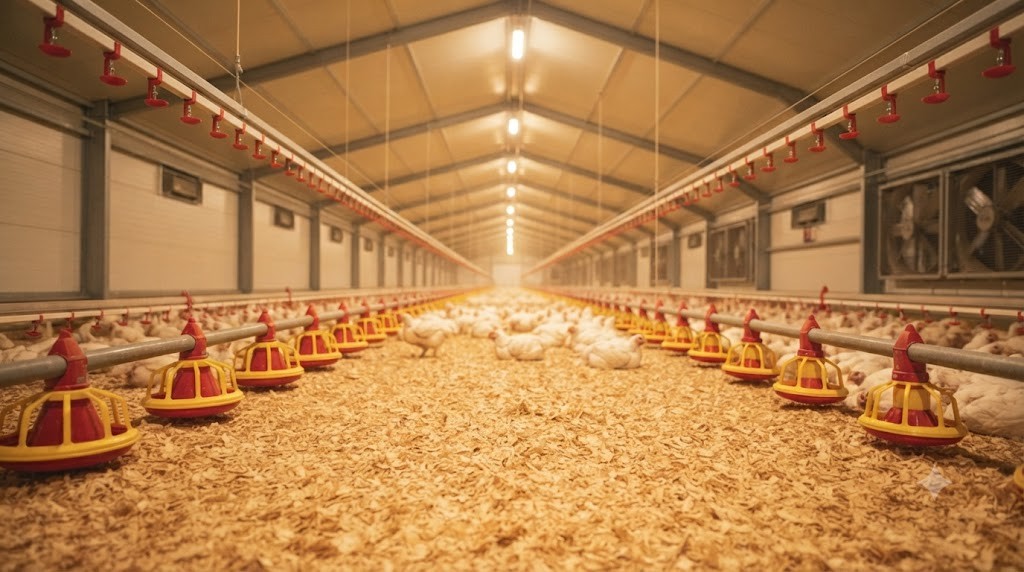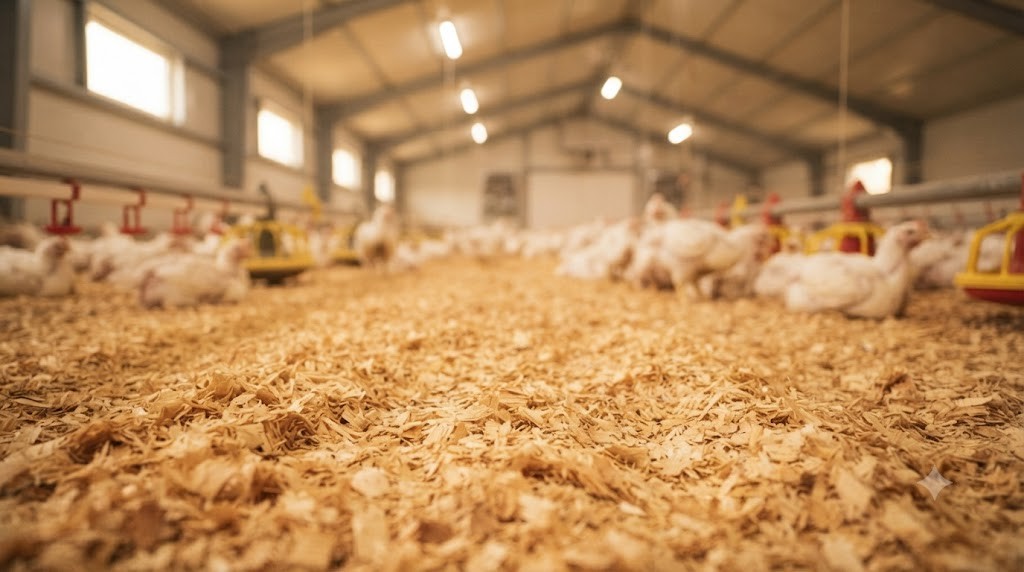
Ventilation is the physical life-support system of the modern commercial poultry facility. Inside a contemporary high-density poultry house—which routinely confines between 25,000 and 50,000 growing broilers or high-producing commercial layers within a single enclosed building—the internal atmosphere is subjected to continuous biological contamination. Every minute, the flock generates monumental volumes of respiratory water vapor, carbon dioxide ($CO_2$), metabolic body heat, and fecal ammonia ($NH_3$). Without an engineered, dynamically controlled ventilation architecture, the interior environment rapidly degrades into a lethal atmosphere of asphyxiating humidity, toxic ammonia, and thermal stress.
Agricultural ventilation is not merely the random movement of air through open windows or sidewall curtains; it is an exact physical discipline governed by fluid dynamics, thermodynamics, psychrometrics, and structural aerodynamics. Modern facilities operate on mechanical negative-pressure ventilation systems that allow computerized environmental controllers to manipulate airflow trajectory, air velocity, and thermal exchange with mathematical precision across all external weather conditions.
🏡
Fluid Dynamics
The Physics of Negative-Pressure Ventilation Systems
All modern solid-sidewall commercial poultry barns operate on the physical principle of negative pressure. Rather than using fans to blow external air into the building (positive pressure, which creates turbulent, uncontrolled air drafts and forces moisture into wall insulation), heavy exhaust fans pull air out of the building.
Creating the Pressure Differential (Static Pressure)
When high-capacity exhaust fans extract air from a tightly sealed house, they remove air molecules faster than new air can enter, creating a partial vacuum. The atmospheric pressure inside the barn becomes lower than the ambient atmospheric pressure outside. This pressure difference is termed static pressure, measured in inches of water column (in. w.c.) or Pascals (Pa).
The standard target static pressure in a well-engineered 40- to 50-foot-wide poultry house ranges between 0.08 and 0.12 inches of water column (20 to 30 Pa). This static pressure drop is what powers the entire air-distribution system: it acts as a mechanical spring, forcing outside air to shoot through calibrated sidewall air inlets at high velocity (typically 800 to 1,200 feet per minute / 4.0 to 6.0 m/s).
The Coanda Effect and Ceiling Air Trajectory
In cold-weather or minimum-ventilation modes, the incoming air from outside is freezing cold (often below 32°F / 0°C). If this heavy, dense cold air simply falls directly onto the floor, it chills the birds, freezes the litter, and triggers acute respiratory infections. Modern housing utilizes the Coanda Effect: high-velocity air jets emerging from directional ceiling inlets cling to the ceiling surface, traveling along the ceiling plane toward the building’s peak.
As cold incoming air travels along the ceiling, it mixes thoroughly with the reservoir of warm air that naturally accumulates at the roof apex (rising thermal heat from the heaters and birds). By the time the mixed air decelerates and gently drops down to bird level in the center of the house, its temperature has warmed by 30°F to 40°F, and its relative humidity has plummeted, transforming it into an absorbent sponge capable of drying floor litter.
| Ventilation Mode | Ambient Weather Condition | Operating Pressure (in. w.c.) | Air Ingress Route | Air Speed at Bird Level | Primary Management Objective |
|---|---|---|---|---|---|
| Minimum Ventilation | Freezing / Cold / Brooding | 0.08 – 0.12 in. w.c. | Perimeter Sidewall Inlets (Ceiling) | < 50 ft/min (Still air) | Moisture removal; oxygen supply; ammonia control (<20 ppm) |
| Transitional Ventilation | Mild / Spring & Autumn | 0.06 – 0.09 in. w.c. | Sidewall Inlets + Large End Inlets | 50 – 150 ft/min | Moderate heat dissipation without direct wind-chill on birds |
| Tunnel Ventilation | Hot Summer (> 82°F / 28°C) | 0.04 – 0.08 in. w.c. | End-Wall Evaporative Cooling Pads | 500 – 700 ft/min | Maximum wind-chill convective cooling; heat stress mitigation |
| Natural Sidewall (Curtain) | Temperate / Emergency Backup | Zero (Atmospheric) | Open Sidewall Drop Curtains | Variable Wind Driven | Low-cost emergency ventilation during total electrical power failure |
🏡
Ventilation Math
The Mathematical Foundations of Minimum Ventilation
Minimum ventilation is operated during brooding, cold weather, or night hours when external ambient temperatures are lower than the house setpoint. The sole mandate of minimum ventilation is air quality control and moisture removal, operating completely independently of temperature thermostats via synchronized cyclic timers.
Calculating Required Airflow (CFM per Bird)
Modern ventilation controllers calculate required Cubic Feet per Minute (CFM) based on bird age, live body weight, and atmospheric moisture generation. The standard baseline calculation for minimum ventilation airflow is:
Minimum CFM = Total Bird Count * CFM Multiplier by Body Weight
Standard engineering multipliers based on broiler live body weight include:
- Day 1 to 7 (Chicks): 0.10 to 0.15 CFM per bird.
- Week 2 (0.4 kg weight): 0.25 to 0.30 CFM per bird.
- Week 3 (0.9 kg weight): 0.45 to 0.55 CFM per bird.
- Week 4 (1.5 kg weight): 0.70 to 0.85 CFM per bird.
- Week 5 to Harvest (2.5 kg weight): 1.10 to 1.35 CFM per bird.
Five-Minute Cycle Timer Mechanics
Minimum ventilation fans operate on a fixed 300-second (5-minute) repeat cycle timer. If a 30,000-bird broiler house at 2 weeks of age requires a total airflow of 9,000 CFM, and the manager operates one 36-inch exhaust fan rated at 10,000 CFM capacity, the required fan runtime is calculated as:
Runtime Fraction = 9,000 CFM / 10,000 CFM = 0.90 (90%)
Runtime = 300 seconds * 0.90 = 270 seconds ON, 30 seconds OFF
The controller runs the fan for 270 seconds, exhausting stale, moisture-laden air, then rests for 30 seconds before repeating the cycle. Under no circumstances should minimum ventilation cycle timers ever be turned off completely; doing so allows lethal ammonia concentrations to spike within 15 minutes.
🏡
Tunnel Cooling
Tunnel Ventilation Engineering and The Wind-Chill Effect
When outdoor temperatures exceed the flock setpoint (typically above 80°F to 85°F / 27°C to 29°C), ventilation strategy transitions completely from moisture removal to maximum heat dissipation via Tunnel Ventilation.
The Wind Tunnel Principle
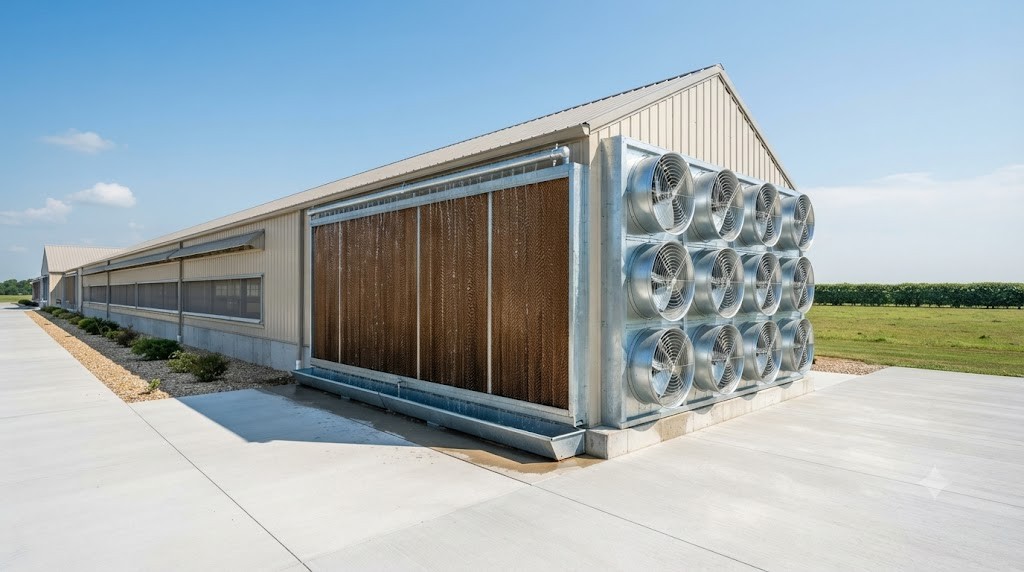
In tunnel mode, all perimeter sidewall inlets are sealed tightly shut. High-volume exhaust fans located exclusively at one end of the building (the tunnel exhaust bank) exhaust air at maximum capacity, while large continuous openings at the opposite end of the house (the tunnel inlet zone) admit vast volumes of air. The entire length of the poultry barn essentially functions as an enclosed, high-velocity wind tunnel.
Calculating Air Velocity and the Wind-Chill Effect
Air velocity down the length of the building must reach 500 to 700 feet per minute (2.5 to 3.5 m/s). The required total exhaust fan capacity is calculated directly from the cross-sectional area of the barn:
Total Tunnel CFM = Cross-Sectional Area (sq. ft.) * Desired Air Speed (ft/min)
For a standard 50-foot-wide barn with a 10-foot average ceiling height (cross-sectional area = 500 sq. ft.), achieving an air speed of 600 ft/min requires: 500 * 600 = 300,000 CFM of total exhaust fan capacity (requiring approximately ten to twelve 54-inch high-efficiency exhaust fans).
Moving air across the birds’ feathered bodies at 600 ft/min strips the boundary layer of trapped hot air from around each chicken, generating a profound convective wind-chill effect. This wind speed lowers the effective sensible temperature felt by the flock by 10°F to 14°F (5.5°C to 7.8°C), allowing heavy meat broilers to remain comfortable and continue feeding during scorching summer heat.
🏡
Evaporative Cooling
Evaporative Cooling Pad Physics and Psychrometrics
When ambient temperatures surpass 90°F (32°C), air velocity alone cannot prevent heat exhaustion. At this threshold, computerized controllers activate Evaporative Cooling Pads installed along the tunnel air inlet openings.
Latent Heat of Vaporization
Evaporative cooling operates on basic thermodynamic psychrometrics: when water evaporates from a liquid into a gas (water vapor), it absorbs thermal energy from the air (the latent heat of vaporization, approximately 2,260 Joules per gram of evaporated water). Water is pumped over fluted cellulose pads (typically 6 inches thick, with cross-fluted 45/15-degree flute angles). Hot, dry outside air pulled through the wetted pads evaporates water, emerging into the poultry house 10°F to 20°F (5.5°C to 11.0°C) cooler than ambient air.
The Relative Humidity Ceiling
However, evaporative cooling pads must be managed with strict psychrometric discipline. As cooling pads evaporate water into the air, the ambient relative humidity inside the barn rises. If house relative humidity exceeds 75% to 80%, the birds’ primary biological defense against heat stroke—panting and gular fluttering—is completely neutralized because moisture cannot evaporate from respiratory air sacs into water-saturated air.
Advanced controllers program cooling pad pumps to operate on interval duty timers (e.g., 30 seconds pump ON, 90 seconds pump OFF) rather than running continuously, keeping the pads damp rather than saturated. If ambient humidity exceeds 80%, controllers automatically lock out pad pumps, relying exclusively on maximum tunnel air speed to protect the flock.
Modern poultry ventilation is an extraordinary synthesis of agricultural architecture and fluid dynamics engineering. By mastering static pressure differential, Coanda ceiling trajectories, minimum ventilation timer math, tunnel air speeds, and psychrometric cooling pad limits, poultry producers construct an uncompromised atmospheric cocoon that guarantees flock health, peak growth, and exceptional enterprise profitability across every season.
🏡
Destratification
Stir Fan Aerodynamics and Thermal Destratification Engineering
One of the most valuable mechanical tools for enhancing internal house microclimates during minimum ventilation is the strategic deployment of internal circulation (stir) fans. Because warm air is naturally buoyant, it rises to the peak of the house, while dense, moisture-laden air settles onto the floor litter.
Throw Distances and Circulation Jet Mechanics
Modern broiler houses suspend internal 24-inch or 36-inch high-efficiency horizontal stir fans (rated at 4,000 to 8,000 CFM) down the center of the house at 50-foot intervals. Fans are angled slightly downward (at a 10- to 15-degree pitch) and staggered to create a gentle, continuous circular racetrack or opposing jet air movement along the ceiling plane.
Operating stir fans breaks the thermal boundary layer at the ceiling, continually mixing warm ceiling air with incoming air from sidewall inlets. This gentle air movement (maintained at 100 to 150 ft/min at floor level) sweeps away stagnant moisture pockets from beneath drinker lines, accelerating litter moisture evaporation without creating direct chilling drafts on young chicks, thereby reducing winter heating gas consumption by 15% to 25%.
🏡
Emergency Systems
Emergency Power Fail-Safe Architectures and Automated Drop Curtains
Operating an environmentally controlled, solid-sidewall poultry facility creates an absolute, non-negotiable dependence on continuous electrical power. In a sealed broiler house holding 30,000 market-weight birds during summer heat, total electrical failure halts ventilation fans instantly. Within 15 to 25 minutes, internal temperatures surge beyond 105°F, oxygen is depleted, and carbon dioxide spikes, leading to 100% flock suffocation.
Automated Generator Transfer and Magnetic Drop Curtains
Every commercial facility must be fortified with redundant, fail-safe emergency infrastructure:
- Standby Diesel Generators with Automatic Transfer Switches (ATS): High-capacity commercial generators (typically 100 to 150 kW per barn) equipped with automatic transfer switches that detect utility grid failure, start automatically, and restore full ventilation power to exhaust fans within 10 to 15 seconds.
- Electromagnetic Winch Curtain Drops: Sidewall emergency curtain panels are held closed by continuous 12-volt electromagnetic latches. If total electrical power fails and the backup generator does not engage within 60 seconds, the magnets de-energize. Heavy counterweights immediately pull the sidewall curtains wide open, enabling emergency natural cross-ventilation.
- Cellular and Radio Telemetry Alarm Dialers: Independent, battery-backed digital security dialers that call multiple phone numbers simultaneously if static pressure drops, power is interrupted, or temperatures deviate beyond critical thresholds.
🏡
Aerodynamic Engineering
Anti-Backdraft Wind Baffles and Fan Shutter Aerodynamics
A frequently overlooked factor in commercial poultry ventilation is the aerodynamic impact of strong prevailing outside winds blowing against exhaust fan discharge cones. When a 25 to 35 mph exterior crosswind blows directly into a running exhaust fan, it creates positive head pressure that resists fan rotation, reducing air output capacity by up to 20% to 30% and causing mechanical fan shutters to flutter noisily.
Inverted Wind Deflection Hoods
Modern ventilation engineering protects exhaust fan banks by installing heavy galvanized steel or fiberglass wind deflection hoods over exterior fan cones. These hoods channel exhaust air downward toward the ground or sideways, deflecting prevailing horizontal winds away from the fan blades. Furthermore, butterfly-style magnetic-closing exhaust shutters seal tightly when fans are idle, completely preventing cold winter backdrafts from penetrating the house.