The contemporary commercial poultry facility is an extraordinary marvel of industrial automation, mechatronics, and real-time sensor network engineering. Managing a modern flock of 30,000 to 50,000 birds within an enclosed 25,000-square-foot building is humanly impossible through manual labor alone. Delivering hundreds of metric tons of feed, hundreds of thousands of liters of sanitized water, and millions of cubic feet of conditioned air every single week demands fully integrated, robotic delivery arrays coordinated by advanced microprocessors.
Modern poultry automation does not merely replace manual farm chores; it elevates flock welfare, eliminates human error, and optimizes biological feed conversion with mathematical consistency. From computer-controlled variable-speed auger pan feeders and pressure-regulated closed nipple drinking systems to sophisticated Internet-of-Things (IoT) environmental controllers monitoring static pressure, carbon dioxide, and bird acoustics, automation represents the indispensable nervous system of modern poultry husbandry.
🏡
Automated Feeders
Automated Pan Feeding Arrays: Auger Mechanics and Sensor Windows
Automated feeding systems must accomplish a complex mandate: delivering feed uniformly to thousands of birds simultaneously across 500-foot-long barns, while preventing selective eating, minimizing physical feed wastage, and stimulating natural flock appetite.
Coreless Flexible Augers and Drive Units
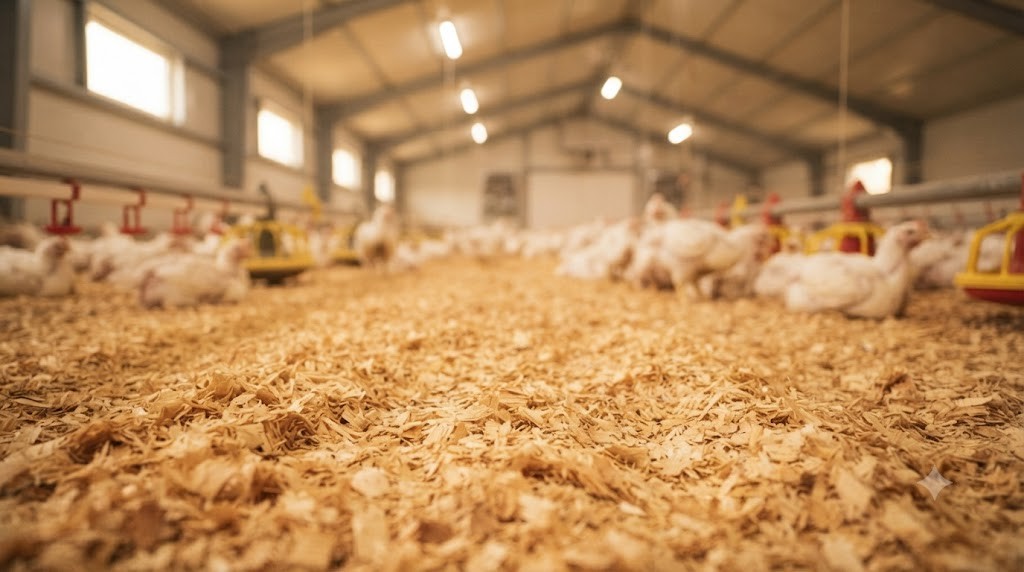
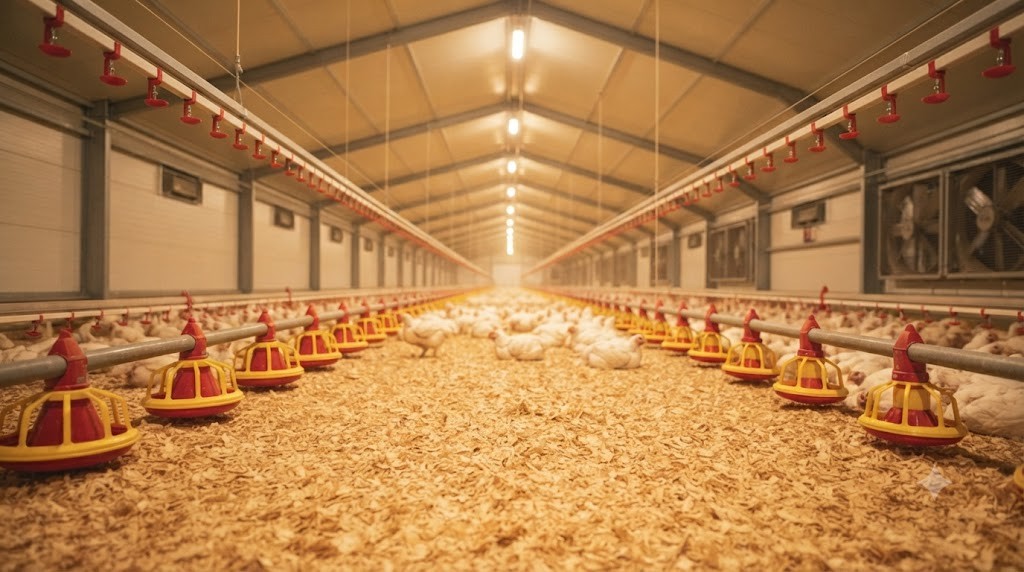
Modern houses utilize enclosed galvanized or PVC feed transport tubes housing high-tensile coreless spiral steel augers. Driven by heavy-duty 0.75-to-1.5-horsepower electric motors, the rotating auger pulls feed from external bulk storage bins, distributing crumbles or pellets through down-drops into individual circular plastic feeder pans spaced every 9 to 10 feet along multiple parallel lines.
The Control Pan Sensor Dynamic
The entire automated feeding line is regulated by a single, critical mechanical or optical sensor located in the terminal control pan at the very end of the line. The operational logic is elegant:
- When feed levels in the terminal control pan drop (as birds consume the feed), an optical infrared sensor or mechanical micro-switch closes, signaling the motor to activate.
- The auger rotates, pulling fresh feed down the entire 500-foot tube, filling all intermediate pans sequentially from front to back.
- Only when the final control pan is completely filled does the sensor open, immediately shutting down the motor.
If intermediate pans are not adjusted properly, birds will empty intermediate pans while the control pan remains full, leaving thousands of birds without feed. Farm managers position control pans in representative, high-traffic zones and calibrate pan flood collars daily.
| Automated System | Primary Mechanical Components | Operational Calibration Metric | Sensor Technology Deployed | Primary Failure Risk |
|---|---|---|---|---|
| Coreless Auger Pan Feeder | Drive motor, helical auger, PVC tube, flood collar | Pan height at bird mid-breast level | Infrared optical sensor / paddle microswitch | Motor burnout; auger binding; bridged silo |
| Enclosed Nipple Drinker Line | Stainless steel pins, PVC pipe, pressure regulator | Water height at bird eye level; 60° reach | In-line pulse flowmeters; digital pressure sensors | Nipple leakage; air locks; biofilm plugging |
| Negative Pressure Controller | Static pressure sensor, inlet winches, VFD fans | 0.08 – 0.12 in. w.c. operating pressure | Diaphragm differential pressure transducer | Belt slippage; lightning surge; stuck inlet doors |
| Thermal Climate Array | Heaters, evaporative cooling pads, tunnel doors | Temperature curve within +/- 0.5°C of setpoint | Solid-state thermistors; digital capacitance hygrometers | Pad scale buildup; gas valve failure; sensor drift |
🏡
Drinking Automation
Enclosed Nipple Drinking Systems: Pressure Regulators and Pin Mechanics
In modern aviculture, open bell drinkers and trough waterers have been entirely superseded by closed, hygienic nipple drinking systems. Open waterers are biosecurity hazards: birds defecate in open water, splash litter, and track pathogens across the barn.
Stainless Steel Nipple Physics: 360-Degree vs. Vertical Action
Modern nipple drinkers utilize precision-machined 300-series stainless steel components housed within high-impact Delrin plastic bodies. The internal mechanism features a precision upper ball and lower triggering pin:
- 360-Degree Action (Brooding Phase): During the first 7 days, newly hatched chicks can activate the pin from any angle—even with a light sideways tap of 2 to 3 grams of force. A drop of water instantly beads on the pin tip, making drinking effortless for small chicks.
- Vertical-Only Action (Growing Phase): As birds mature and drinker line height is elevated, birds drink reaching straight upward. In this orientation, only vertical movement triggers water flow, delivering high flow rates (70 to 100 mL/minute) with zero side splashing.
Digital Pressure Regulators and Sight-Tube Management
Water pressure inside enclosed nipple pipes must be exceptionally low—measured not in pounds per square inch (PSI), but in inches of static water head height visible in transparent riser sight tubes. On day 1, water head height is calibrated to merely 2 to 4 inches (5 to 10 cm) of column height. As birds grow, pressure is increased weekly up to 14 to 18 inches (35 to 45 cm) to satisfy elevated water volume demands without causing leaking nipples.
🏡
Smart Controllers
Integrated Smart Environmental Controllers: The Digital Brain
The operational center of the poultry house is the centralized digital environmental controller (such as Chore-Time Chore-Tronics, Cumberland Edge, or Fancom). These specialized industrial computers continuously poll arrays of digital sensors installed throughout the house, executing complex algorithms to coordinate heating, ventilation, cooling, and lighting.
Sensor Inputs and Data Acquisition
A modern 500-foot barn deploys extensive digital instrumentation:
- Multi-Point Temperature Sensors: Six to eight solid-state digital thermistors spaced throughout the barn average internal temperatures, preventing localized hot or cold zones from skewing controller decisions.
- Capacitive Humidity Sensors: Monitor indoor relative humidity, automatically activating minimum ventilation purging cycles if humidity exceeds 65%.
- Differential Pressure Transducers: Measure static pressure to the thousandth of an inch of water column, instantly signaling motorized sidewall inlet winches to open or close to maintain precise air speed.
- Carbon Dioxide and Ammonia Transducers: NDIR (Non-Dispersive Infrared) sensors monitor $CO_2$ and electrochemical sensors track $NH_3$, triggering emergency fan stages if air quality deteriorates.
Staged Variable-Frequency Drive (VFD) Fan Control
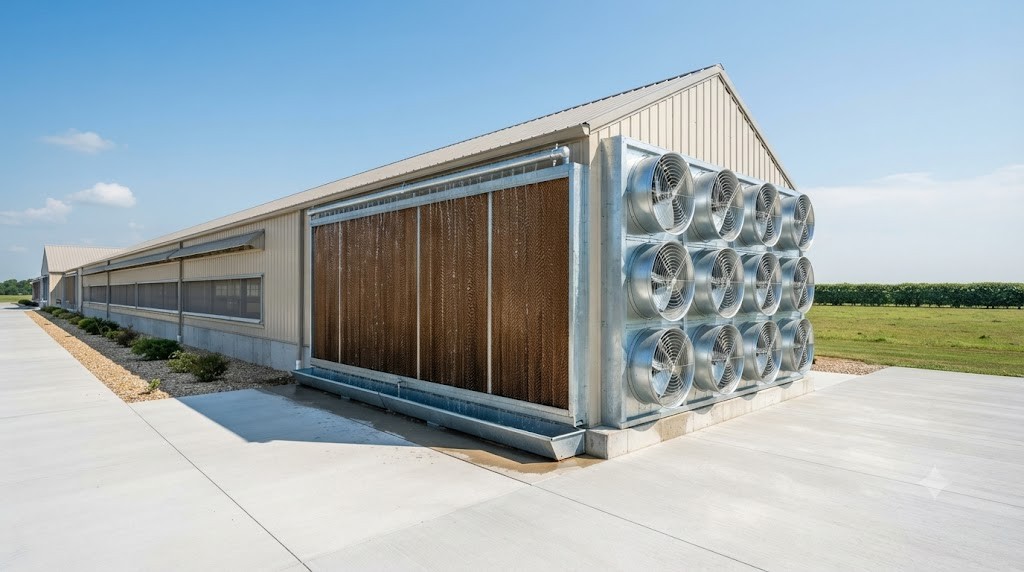
Historically, ventilation fans could only be toggled on or off in crude discrete stages. Today’s facilities employ Variable Frequency Drives (VFDs) on primary exhaust fans. VFDs modulate the electrical frequency supplied to the motor, allowing fans to run smoothly at 10%, 35%, or 80% speed. This provides seamless, stepless air exchange adjustments, eliminates jarring static pressure spikes, and cuts electrical power consumption by 30% to 50%.
🏡
Predictive Analytics
Acoustic Flock Monitoring and Predictive AI Analytics
The cutting edge of commercial poultry engineering involves the deployment of artificial intelligence (AI) and continuous bio-acoustic sensors suspended from the house ceiling:
Bio-Acoustic Cough and Rale Detection
Machine-learning acoustic algorithms continuously record flock vocalizations. Sophisticated algorithms distinguish normal contented chirping from the characteristic high-frequency ‘snicking’ and coughing rales caused by emerging Infectious Bronchitis or Mycoplasma infections. Acoustic sensors detect subclinical respiratory outbreaks 48 to 72 hours before human caretakers can hear them, alerting farm veterinarians to initiate immediate diagnostic swabs and interventions.
Automated In-House Optical Bird Weighing
Manual bird weighing is labor-intensive and induces catching stress. Modern barns suspend automated optical hanging scales or ground-based step-on load cells. As birds hop onto scales throughout the day, the computer logs thousands of individual weights, graphing flock growth curves, standard deviations, and coefficient of variation (CV) in real time on the grower’s smartphone.
By uniting precision mechanical auger feeding, pressure-regulated nipple lines, micro-climate computer coordination, and predictive bio-acoustic analytics, automated poultry systems empower farm managers to achieve unprecedented levels of animal welfare, biological efficiency, and sustainable commercial success.
🏡
Automated Weighing
Automated In-House Bird Weighing Platforms and Growth Telemetry
Accurately tracking daily flock body weight gain and weight uniformity is the foundation of precision broiler management. Historically, managers had to manually catch and weigh 100 birds with spring scales, inducing intense catching stress and providing only a single static data point per week.
Automated Step-On and Hanging Load Cells
Modern poultry barns suspend automated electronic weighing scales—either circular hanging platforms or ground-level step-on load cells—distributed throughout the house. As broilers naturally hop onto the platform throughout the day, the sensitive strain-gauge load cell records the bird’s weight in milliseconds, transmitting the digital reading to the central controller.
The controller’s software executes sophisticated statistical filtering algorithms, automatically discarding anomalous readings (such as two birds jumping on simultaneously or a bird brushing against the platform). The system logs 2,000 to 5,000 valid individual bird weights every 24 hours, automatically graphing average daily gain, coefficient of variation (CV), and standard deviation. Integrator field managers monitor these real-time weight curves remotely on cloud dashboards, scheduling harvesting and feed deliveries with perfect logistical timing.
🏡
Telemetry & Alarms
Digital Alarm Architectures and Cellular Cloud Gateways
A sophisticated automation array is only as reliable as its emergency alarm monitoring architecture. High-capacity commercial poultry operations employ redundant, multi-layered telemetry systems that function completely independently of the primary house controller:
Autonomous Watchdog Safety Circuits
Secondary analog mechanical thermostats (independent of the computerized controller) are wired into dedicated alarm circuits. If the primary computerized controller freezes, suffers a lightning surge, or fails, the secondary mechanical thermostat triggers an immediate alarm siren if house temperatures rise above 90°F or drop below 60°F.
Concurrently, cellular IoT gateways continuously mirror house sensor data to encrypted cloud servers. If the system detects abnormal water consumption spikes (indicating a severed water line), zero water flow for 3 hours (plugged filters), or auger motor run-time limits being exceeded (empty feed bins), the gateway immediately dispatches high-priority SMS alerts and automated voice calls to farm managers’ mobile devices, guaranteeing instant intervention before flock welfare is compromised.
🏡
Feed Telemetry
Batch Weigher Hoppers and Daily Feed Intake Telemetry
Modern automated feeding arrays rely on electronic batch weigher hoppers installed directly beneath the bulk storage silos. Instead of estimating feed consumption based on visual silo levels, incoming feed is weighed in precise 50-to-100-kg batches inside an enclosed load-cell hopper before being augered into the house.
Real-Time Feed Intake Curves
The central controller logs the exact cumulative kilogram weight of feed delivered each hour, comparing it automatically to standard breeder growth curves. If feed consumption plateaus or drops by even 5% compared to the previous day’s intake curve, the controller flags an immediate warning. Because a sudden drop in feed consumption is the very first clinical indicator of emerging viral disease, water line failure, or toxic mycotoxin contamination, feed telemetry provides growers with vital 24- to 48-hour early diagnostic advantages.
🏡
Water Telemetry
Water Meter Analytics: The Primary Biomarker of Flock Vitality
While feed intake is monitored closely, electronic pulse water meters (measuring water flow down to 0.1 liters) function as the ultimate instantaneous biomarker of flock health. Chickens drink with absolute chronological regularity throughout the photoperiod.
Interpreting Water-to-Feed Consumption Ratios
Under thermoneutral conditions, the ratio of water-to-feed consumption remains rock-solid between 1.8:1 and 2.0:1. Deviations in this ratio provide precise diagnostic clues:
- Water Ratio Surging Above 2.5:1: Indicates acute thermal heat stress (birds drinking to cool down), elevated dietary sodium, or severe osmotic diarrhea.
- Water Ratio Dropping Below 1.5:1: Indicates water line airlocks, excessive water line pressure, foul water taste due to chemical sanitizer overdose, or emerging subclinical respiratory infection.
🏡
Rigging Engineering
Motorized Ceiling Winch Hoisting and Clean-Out Rigging
A vital operational requirement in modern poultry house engineering is the ability to clear the entire floor space rapidly during flock harvest and terminal clean-out. Automated pan feeder lines and enclosed nipple drinker lines run the entire 500-foot length of the building, representing tons of physical equipment suspended above the litter.
Centralized Cable Winch Mechanics
Modern houses install heavy-duty centralized electric cable winches (rated at 1,500 to 2,500 lbs dead-lift capacity) connected to high-tensile 3/16-inch galvanized aircraft cables passing through self-lubricating nylon ceiling pulleys spaced every 8 to 10 feet along each line. Within less than five minutes of pressing a button on the central control panel, an operator can hoist all feeder and drinker lines simultaneously up to the ceiling trusses, lifting equipment 8 to 10 feet above the floor.
This automated clearance allows commercial skid-steer loaders, tractor-mounted litter de-caking machines, and manure spreader trailers to operate unimpeded across the floor slab during clean-out without risking damage to delicate plastic pans, electrical sensor cables, or stainless-steel nipple assemblies. Once clean bedding is spread, lines are lowered and leveled with millimeter precision.