Lighting is the primary environmental conductor of avian reproduction, behavior, and metabolic performance. Unlike mammals whose circadian and seasonal endocrine rhythms are governed primarily through ocular retinal pathways, the domestic chicken possesses an extraordinarily complex, multi-tiered visual and extra-retinal photoreceptive architecture. In poultry management, light is not merely illumination to facilitate feeding; light is a biological drug. The duration (photoperiod), intensity (lux), spectrum (wavelength), and uniformity of light directly dictate when a pullet reaches sexual maturity, how persistently she ovulates, and whether flock behavior remains calm or deteriorates into destructive feather pecking.
Developing an optimized commercial lighting program requires deep comprehension of avian biophysics. A failure in lighting management—such as precocious photostimulation of underweight pullets, inconsistent timer clocks, or improper spectral choice—can permanently impair a flock’s lifetime yield by dozens of eggs per hen, while precipitating fatal behavioral outbreaks of cannibalism and uterine prolapse.
🥚
Avian Photoreception
Avian Photoreception Biophysics: Retinal vs. Extra-Retinal Pathways
To design scientifically rigorous lighting regimes, one must contrast avian photoreception with human visual biology. Humans perceive light through trichromatic vision via three cone photoreceptors in the retina (sensitive to blue, green, and red light). In contrast, domestic chickens possess sophisticated tetrachromatic vision:
- Four Retinal Cones: Chickens possess four distinct single retinal cones with peak spectral sensitivities at 415 nm (ultraviolet-A / violet), 455 nm (blue), 535 nm (green), and 570 nm (red), alongside specialized double cones utilized for motion detection.
- Ultraviolet Perception: Because chickens perceive UVA wavelengths (320 to 400 nm), they see feather iridescence, flock social hierarchies, eggshell markings, and feed particle textures in visual dimensions completely invisible to human eyes.
- Extra-Retinal Hypothalamic Photoreceptors: Crucially, sexual reproduction in chickens is mediated primarily through extra-retinal deep-brain photoreceptors located in the basal hypothalamus and pineal gland. Light does not need to enter the eye; photons pass directly through the skin, skull cranium, and brain tissue to stimulate hypothalamic photoreceptors directly.
The Penetration Power of Red Wavelengths
The avian cranium acts as a physical wavelength filter. Short wavelengths of light (such as blue and green, 400 to 500 nm) scatter easily and fail to penetrate cranial bone. In contrast, long-wavelength red light (630 to 660 nm) possesses superior tissue-penetrating capability, readily passing through the skull to stimulate hypothalamic opsins. When stimulated by red photons, the hypothalamus releases gonadotropin-releasing hormone (GnRH), triggering the pituitary release of follicle-stimulating hormone (FSH) and luteinizing hormone (LH), thereby driving ovarian follicular development and egg production.
| Life Stage | Age (Weeks) | Target Daily Photoperiod | Light Intensity (Lux at Feeder) | Recommended Color Spectrum | Primary Management Objective |
|---|---|---|---|---|---|
| Brooding (First 3 Days) | Day 0 – 3 | 22 – 23 Hours | 30 – 40 Lux | Broad Neutral (3,500K) | Ensure rapid chick feed find and water discovery |
| Early Rearing | Day 4 – Wk 6 | Step down to 10 – 12 Hours | 15 – 20 Lux | Neutral White | Prevent hyper-activity; foster uniform skeletal growth |
| Late Rearing (Dark-Out) | Wk 7 – 16 | Constant 8 – 9 Hours | 5 – 10 Lux | Neutral / Dimmable | Prevent precocious sexual maturity; maintain calm |
| Photostimulation Trigger | Wk 17 | Surge to 11.5 – 12.0 Hours | 20 – 30 Lux | Warm Red (2,700K – 3,000K) | Stimulate hypothalamic GnRH; initiate ovarian growth |
| Ascending Lay Phase | Wk 18 – 24 | Step up 30 min/wk to 14.5 – 15 Hours | 25 – 30 Lux | Warm Red (2,700K) | Synchronize ovulatory peak with feed intake capacity |
| Peak Plateau to End-of-Lay | Wk 25 – 80+ | Constant 15.5 – 16.0 Hours | 20 – 30 Lux | Warm Red (2,700K) | Maintain relentless persistency; NEVER decrease light |
🥚
Lighting Architecture
The Cardinal Rules of Poultry Lighting Programs
Over seven decades of commercial poultry science research, two golden, unbreakable rules have been codified for replacement pullets and commercial layers:
Rule 1: Never Allow Growing Pullets to Experience Increasing Day Length
Between 6 and 16 weeks of age, pullets must never experience an increasing photoperiod. In naturally ventilated or open-sided houses in temperate regions, spring-hatched pullets naturally experience expanding day lengths as summer approaches. Increasing day length during rearing triggers premature sexual maturity before the pullet has achieved sufficient skeletal frame size and muscular body mass.
A pullet that begins laying prematurely will produce tiny peewee eggs for months, suffer high rates of fatal vent prolapse (blowouts) because her pelvic canal is too narrow, and experience severe mid-cycle production crashes. In modern production, pullets are reared exclusively in light-tight, dark-out houses maintained on a strict constant 8- to 9-hour photoperiod.
Rule 2: Never Allow Laying Hens to Experience Decreasing Day Length
Once a flock commences laying, the total daily photoperiod must never be reduced, even by 15 or 30 minutes. In avian evolutionary biology, a diminishing photoperiod is the universal biological cue that winter is approaching, which immediately triggers the cessation of ovulation, ovarian regression, and the shedding of feathers (molt).
Even an accidental timer failure or power disruption that shortens the photoperiod for three or four consecutive days can throw an entire high-producing flock into an unplanned catastrophic molt, causing egg production to plummet from 95% down to 20% within two weeks. Backup battery timers and automated generator transfer switches are mandatory farm infrastructure.
🥚
Stimulation Protocols
Photostimulation Protocols: Age vs. Body Weight Criteria
One of the most consequential decisions facing a poultry manager is timing the initial photostimulation trigger. Historically, managers stimulated flocks based purely on chronological age (e.g., exactly at 17 or 18 weeks).
The Primacy of Body Weight and Uniformity
Modern management dictates that flocks must be photostimulated based strictly on body weight targets and flock uniformity, not chronological age. The physiological threshold for successful photostimulation requires:
- The flock must achieve the breeder’s target body weight baseline (typically 1.35 to 1.45 kg for brown layers, 1.25 to 1.30 kg for white layers).
- Flock uniformity must exceed 85% (meaning at least 85% of sampled birds weigh within +/- 10% of the flock mean).
- Pullets must possess sufficient abdominal fat pad reserves (palpated at the pelvic keel) to support the tremendous energy draw of early egg synthesis.
If a flock is underweight at 17 weeks due to prior health challenges or hot weather, photostimulation must be delayed by one to two weeks, maintaining the 8-hour rearing photoperiod while feeding nutrient-dense developer rations until target body weight and frame size are recovered.
🥚
Illumination Engineering
Light Intensity, Distribution Uniformity, and Flicker Frequency
Beyond duration and spectrum, the physical quality of the installed illumination equipment directly influences flock behavior:
Lux Uniformity and Eliminating Shadow Zones
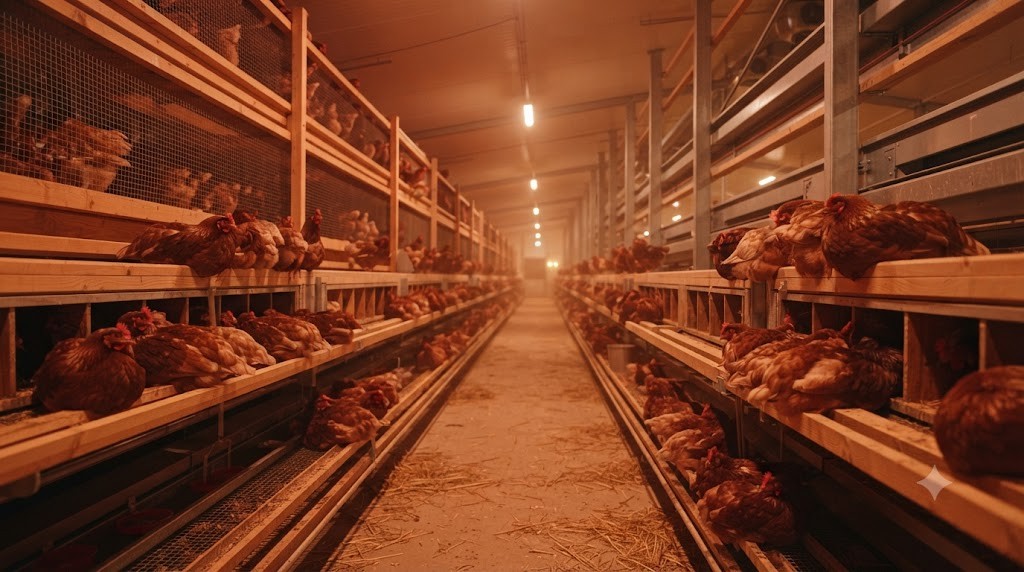
In cage-free aviary and floor-housing systems, light distribution must be exceptionally uniform. Dark shadows under system platforms, in corners, or along walls create inviting nesting sanctuaries, tempting pullets to deposit eggs on the litter floor rather than walking up into automated nest boxes. Maintaining 25 to 30 lux at floor level in activity corridors while keeping the interiors of communal nest boxes attractively dim (under 1 to 2 lux via private curtains) is the key to training hens to use nest boxes and eliminating costly floor eggs.
The Danger of LED High-Frequency Flicker
The avian eye possesses a Critical Flicker Fusion Frequency (CFFF) exceeding 100 to 105 Hertz (Hz), whereas human vision perceives light as continuous above approximately 50 to 60 Hz. Cheap commercial LED bulbs or incompatible electronic dimming circuits frequently pulse at 100 to 120 Hz.
While humans perceive this illumination as steady, chickens perceive it as an agonizing, continuous high-speed disco strobe light. Constant visual flicker causes chronic sensory stress, elevates plasma corticosterone concentrations, and triggers explosive outbreaks of aggressive feather pecking and cannibalism. Poultry houses must utilize certified poultry-specific agricultural LED drivers with pulse-width modulation (PWM) operating at frequencies above 2,000 Hz or smooth linear DC voltage dimming.
🥚
Dimming Protocols
Dusk and Dawn Simulation Dynamics
In automated housing, lights should never click abruptly on or off at full intensity. Abrupt shutoffs in cage-free barns trigger panic piling, where thousands of startled birds scramble blindly into corners, suffocating bottom birds. Modern digital lighting controllers program a 15- to 30-minute graduated ‘dawn’ ramp and ‘dusk’ ramp.
During the dusk cycle, lighting intensity slowly diminishes over 20 minutes, simulating natural sunset. This gradual dimming signals the birds’ instinctive perching behavior: hens calmly ascend from the litter floor, climb aviary platforms, and settle comfortably onto perches before total darkness settles, completely eliminating evening floor smothering.
By mastering the biophysics of avian extra-retinal photoreception, enforcing strict photoperiod consistency, matching spectra to developmental life stages, and eliminating LED flicker, poultry producers harness light as a precise management instrument to optimize welfare, sustain relentless lay persistency, and safeguard enterprise profitability.
🥚
Molt Management
Non-Feed Withdrawal Molting Programs and Photoperiod Restriction
When a commercial laying flock reaches 70 to 80 weeks of age, ovulatory persistency naturally declines, and eggshells become increasingly fragile. To extend the productive life of the flock into a second laying cycle without purchasing expensive replacement pullets, farm managers implement an induced molt program.
The Modern Animal-Welfare-Compliant Protocol
Modern animal welfare standards (such as United Egg Producers guidelines) strictly prohibit traditional fasting or feed-withdrawal molting. Today’s commercial facilities utilize low-energy, high-fiber nutritional molting programs paired with decisive lighting reductions. The flock’s daily photoperiod is abruptly reduced from 16 hours to a non-stimulating 8 hours per day. Simultaneously, the standard layer diet is replaced with a low-sodium, high-fiber ration composed of wheat middlings, alfalfa meal, or soybean hulls.
The combination of an 8-hour day length and dietary dilution triggers a natural neuroendocrine cascade: the hypothalamus ceases GnRH secretion, the pituitary halts LH and FSH release, and circulating estrogen levels plummet. Within 5 to 7 days, egg production drops to zero, and the flock enters a rapid feather molt. Over the subsequent 28-day resting period, the oviduct involutes and regenerates its glandular epithelium, cellular debris is cleared from the uterine mucosa, and bone mineral reserves stabilize. When lights are systematically increased back to 16 hours and high-calcium layer feed is reintroduced, the flock surges into a second lay cycle, achieving peak production of 80% to 85% with restored shell strength.
🥚
Chronobiology
Pineal Gland Melatonin and Circadian Pacemakers
Circadian synchronization in poultry is driven by the rhythmic nocturnal secretion of the hormone melatonin. Melatonin is synthesized primarily by the pineal gland and the ocular retina during hours of darkness. High levels of circulating nighttime melatonin act as a biological pacemaking signal that suppresses premature hypothalamic reproductive stimulation while regulating immune cell proliferation and cellular antioxidant defenses.
When artificial lights in the poultry house illuminate during the dark period—whether due to light leaks around ventilation exhaust fans (poor light-trapping) or erratic timer switches—melatonin secretion is instantly suppressed. Chronically disrupted melatonin rhythms induce severe endocrine desynchronization, impairing ovulatory timing, elevating flock stress hormones (corticosterone), and precipitating erratic double-yolk ovulations and internal egg laying.
🥚
Fixture Engineering
Engineering Specifications for Agricultural LED Lighting Fixtures
Operating lighting equipment inside commercial poultry barns exposes electrical hardware to severe environmental hazards, including corrosive ammonia vapors (exceeding 25 to 50 ppm in poorly ventilated litter houses), fine organic feather dust, and high-pressure hot-water washdowns during terminal house sanitization.
Ingress Protection (IP66 & IP69K) and Ammonia Resistance
Standard residential or commercial office LED fixtures fail within weeks in a poultry house. Agricultural fixtures must carry certified IP66 or IP69K ingress protection ratings, indicating total dust-tight sealing and the capability to withstand high-pressure, high-temperature washdown jets (up to 100 bar at 80°C). Furthermore, fixture housings must be manufactured from corrosion-proof extruded polycarbonate or specialized marine-grade aluminum, utilizing silicone gaskets rather than rubber seals that degrade when exposed to atmospheric ammonia and disinfectant quats.
Thermal Dissipation and L70 Lumen Maintenance
Because poultry house ceilings accumulate heat, LED drivers must feature robust internal heat sinks that maintain junction temperatures below 75°C. Selecting commercial fixtures with an L70 rating exceeding 50,000 hours guarantees that light output will not decay below 70% of initial lumen output over years of continuous operation, ensuring that flock photostimulation intensity remains steady and uniform throughout the flock’s lifetime.