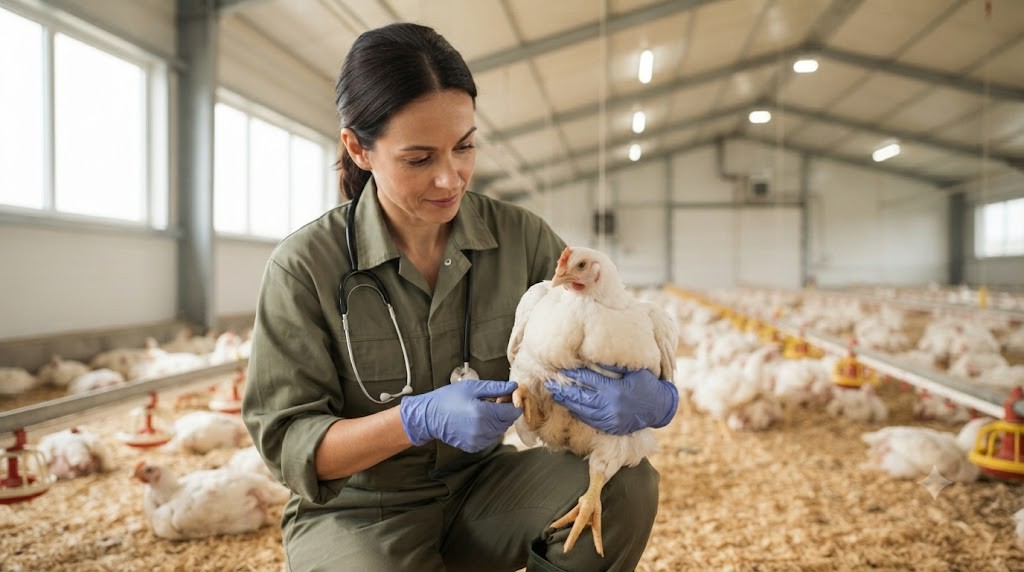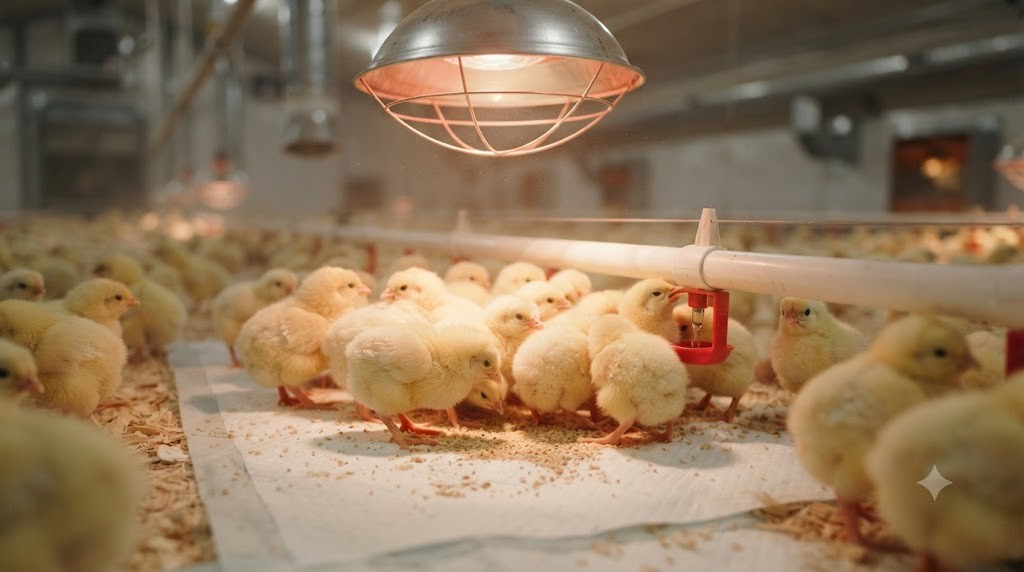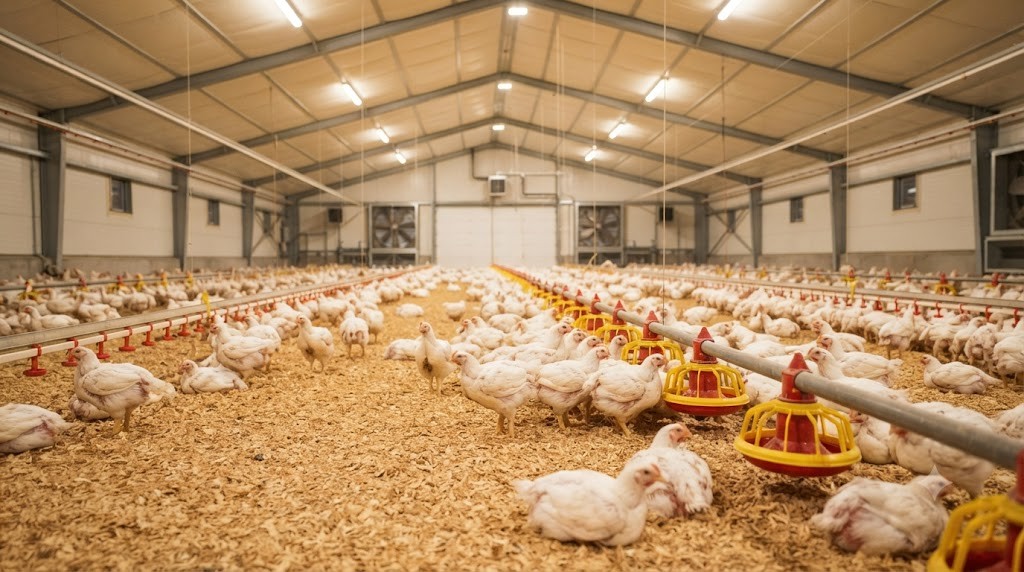
The modern meat broiler (Gallus gallus domesticus) represents the most biologically efficient terrestrial livestock converter of plant feedstuffs into high-density human dietary protein on Earth. Over the past seven decades, quantitative avian genetics, pedigree family selection, and advanced genomic mapping have transformed the broiler chicken from a slow-growing 16-week farmyard bird into a precision animal reaching a live body weight of 5.5 pounds (2.5 kg) in merely 35 to 42 days, achieving a feed conversion ratio (FCR) hovering near 1.50 to 1.65 kilograms of feed per kilogram of live gain.
Understanding broiler breeding architecture is critical for modern commercial farm managers, integrators, and agricultural economists. Commercial broilers are not open-pollinated breeds; they are highly proprietary, four-way terminal crossbred commercial hybrids produced by multinational primary breeding corporations (predominantly Aviagen and Cobb-Vantress). This extensive guide examines the genetic foundations of the primary global meat lineages—Ross 308, Cobb 500, and Hubbard—alongside physiological growth dynamics, muscle fiber hyperplasia, and feed conversion optimization.
📈
Breeding Pyramid
The Pyramid Architecture of Commercial Poultry Breeding
The global commercial broiler supply chain operates as a strict four-tiered genetic multiplication pyramid. This structure allows elite genetic gains achieved at the research apex to be rapidly disseminated across billions of commercial birds worldwide while safeguarding proprietary purebred pedigree lines:
- Pedigree Level (Apex): Individual pure lines numbering a few thousand elite birds maintained under ultra-secure biosecurity conditions. Breeders record over 50 phenotypic traits per bird, utilizing computerized tomography (CT) scanners to measure skeletal mineral density and breast muscle volume in live candidates.
- Great Grandparents (GGP): Pedigree selections are multiplied to create homozygous parent lines, systematically selecting for specific male lines (sire line: growth rate, breast meat yield, FCR) and female lines (dam line: egg production, fertility, chick hatchability).
- Grandparents (GP): Crosses between GGP lines produce commercial parent stock (broiler breeders). Grandparent flocks are distributed internationally to regional multiplier hatcheries.
- Parent Stock (PS – Broiler Breeders): Commercial breeder farms cross the male parent line with the female parent line to produce billions of fertile hatching eggs, which hatch into terminal commercial broilers.
📈
Strain Profiles
Comparative Evaluation: Ross 308 vs. Cobb 500 vs. Hubbard
The global meat bird sector is dominated by specific commercial strains, each bred with distinct performance profiles tailored to regional market processing demands and feed ingredient economics.
1. The Ross 308: Balanced Efficiency and Global Versatility
Developed by Aviagen, the Ross 308 is the most widely distributed commercial broiler strain in the world. Its genetic selection emphasizes robust cardiovascular capacity, exceptional leg strength, high survivability under diverse environmental conditions, and consistent breast meat deboning yield.
The Ross 308 performs exceptionally well across a wide spectrum of nutritional planes, thriving on both high-density corn-soy diets and lower-density alternative grain formulations (such as wheat, barley, and sorghum). It features an assertive feeding temperament, robust appetite, and predictable feed conversion curves, making it the preferred choice for integrated operations operating in varied climatic zones from North America to Southeast Asia.
2. The Cobb 500: The Breast Meat Deboning Titan
Developed by Cobb-Vantress, the Cobb 500 is engineered specifically for operations prioritizing maximum white breast meat yield and lowest cost per pound of deboned meat. The Cobb 500 exhibits a distinctive broad, blocky breast conformation with exceptional early growth velocity.
A signature physiological advantage of the Cobb 500 is its outstanding feed conversion ratio on lower-density, lower-protein grower rations. Cobb genetics are selected to optimize nutrient utilization on cost-effective diets, allowing integrators to reduce expensive soybean meal inclusion. The Cobb 500 also exhibits excellent processing uniformity, yielding high carcass evisceration percentages and smooth automated deboning line performance.
3. The Hubbard Strains: Slow-Growing and Animal Welfare Strains
As animal welfare organizations in Europe and North America advance frameworks like the Better Chicken Commitment (BCC), consumer demand for slower-growing broiler breeds has surged. Hubbard (a division of the Aviagen Group) is the global leader in slow-growing and intermediate meat genetics, producing strains such as the Hubbard JA57 and Redbro.
Hubbard alternative broilers grow at a controlled rate (daily gain averaging 45 to 50 grams per day versus 65 to 70 grams for conventional strains), reaching market weight in 50 to 56 days. These birds demonstrate superior natural mobility, active perching behavior, lower incidence of footpad dermatitis, and zero occurrence of breast muscle myopathies, commanding significant retail price premiums in certified organic and free-range markets.
| Broiler Strain | Target Market | Age to 2.5 kg (Days) | Feed Conversion Ratio (FCR) | Breast Meat Yield (% Carcass) | Leg & Skeletal Strength | Primary Operational Fit |
|---|---|---|---|---|---|---|
| Ross 308 | Global Integrated | 34 – 36 Days | 1.52 – 1.58 | 23.5 – 24.5% | High Robusticity | All-climate versatility; broad dietary adaptability |
| Cobb 500 | Deboning / Cut-Up | 33 – 35 Days | 1.50 – 1.56 | 24.5 – 25.5% | Moderate to High | Maximum breast yield; low-density feed economy |
| Ross 708 | Heavy Deboning | 42 – 46 Days (3.5 kg) | 1.65 – 1.72 | 26.0 – 27.5% | High | Heavy bird processing; industrial portion control |
| Hubbard JA57 | Better Chicken (BCC) | 50 – 56 Days | 1.95 – 2.10 | 19.5 – 21.0% | Superior (Agile) | Pastured, organic, and certified humane programs |
| Sasso / Redbro | Label Rouge / Free-Range | 65 – 84 Days | 2.30 – 2.55 | 17.0 – 18.5% | Extreme Hardiness | Traditional gourmet cuisine; outdoor foraging systems |
📈
Muscle Biology
Cellular Myogenesis and Muscle Hyperplasia vs. Hypertrophy
To comprehend how modern broilers achieve such dramatic meat yields, one must examine avian muscle cell biology (myogenesis). Muscle mass is governed by two distinct cellular mechanisms: hyperplasia (the multiplication of muscle fiber numbers) and hypertrophy (the increase in diameter and volume of existing muscle fibers).
Embryonic Muscle Fiber Hyperplasia
In domestic poultry, hyperplasia of muscle fibers is completed entirely during embryonic incubation inside the egg. At the moment the chick pips through the shell on day 21, the absolute number of muscle fibers in the pectoralis major (breast muscle) is permanently fixed for the bird’s entire lifetime. No new muscle fibers can ever be formed post-hatch.
Consequently, incubator management during embryonic myogenesis (days 12 to 18 of incubation)—specifically regulating eggshell temperature strictly between 100.0°F and 100.5°F (37.8°C) and maintaining uniform ventilation—is vital. Thermal overheating during incubation stunts muscle satellite cell proliferation, permanently reducing the total fiber count and capping the bird’s lifetime breast yield potential regardless of feed quality.
Post-Hatch Muscle Hypertrophy and Satellite Cells
Post-hatch muscle growth occurs exclusively through hypertrophy: the volumetric enlargement of existing muscle fibers. This expansion is powered by specialized myogenic stem cells known as satellite cells located beneath the basal lamina of muscle fibers. During the first week of life, satellite cells undergo intense mitotic proliferation, donating their nuclei into existing muscle fibers (myotubes) to provide the genetic transcription machinery required for rapid protein accretion.
If newly hatched broiler chicks experience brooding chills, dehydration, or delayed feed access, satellite cell mitotic activity is severely impaired, permanently blunting breast meat deposition. Providing immediate brooding feed access within hours of hatch is therefore essential to unlock the bird’s full genetic potential.
📈
FCR Economics
Feed Conversion Ratio (FCR): The Mathematical Engine of Profitability
Feed Conversion Ratio (FCR) is the definitive economic benchmark in commercial broiler production. It represents the mass of feed consumed divided by the live body mass gained by the flock:
FCR = Total Feed Consumed (kg) / Total Live Body Weight (kg)
The Financial Leverage of an FCR Point
In modern commercial poultry operations, FCR is measured down to the third decimal place, with a 0.01 change referred to as ‘one point of FCR’. For an enterprise-scale poultry integration producing 50 million broilers per year, improving flock FCR by merely one single point (0.01) saves over 1,250 metric tons of finished feed, translating directly to hundreds of thousands of dollars in net annual cost savings.
Adjusting FCR for Standard Weight (Weight-Corrected FCR)
Because heavier birds naturally have higher maintenance energy requirements and consequently higher FCRs, comparing flocks harvested at different weights requires calculating Weight-Corrected FCR (Adjusted FCR). The standard industry formula adjusts FCR by 1 point for every 25 to 30 grams of body weight difference:
Adjusted FCR = Observed FCR – [ (Observed Weight – Standard Target Weight) / 2.5 ]
This standardized calculation allows managers to accurately evaluate feed formulation efficacy, housing ventilation performance, and disease challenge severity independently of harvest age variations.
📈
Myopathy Diagnostics
Modern Breast Myopathies: Wooden Breast, White Striping, and Spaghetti Meat
The intense selective pressure for hyper-accelerated breast muscle hypertrophy has inadvertently precipitated emerging macroscopic breast muscle myopathies in modern heavy broilers:
- Wooden Breast (WB): Characterized by severe palpated hardness, pale coloration, and mucosal exudation across the pectoralis major. Histologically, muscle fibers undergo polyphasic degeneration, myodegeneration, and extensive interstitial fibrosis, where dead muscle fibers are replaced by rigid cross-linked collagen connective tissue.
- White Striping (WS): Manifests as visible white striations running parallel to muscle fibers along the breast fillet surface. Chemical analysis reveals these white stripes represent localized lipid and fibrous tissue deposition, lowering fillet protein content and increasing fat percentage.
- Spaghetti Meat (SM): Severe loss of structural integrity in the breast fillet, causing muscle fiber bundles to fray and separate into loose strands resembling shredded pasta. Attributed to compromised collagen architecture and accelerated turnover of perimysial connective tissue.
Ultimately, modern broiler genetics represent an extraordinary pinnacle of quantitative biological science. By understanding genetic strain selection, cellular muscle kinetics, least-cost FCR mathematics, and proactive myopathy mitigation, poultry producers successfully balance high meat yield with optimal animal welfare and sustainable operational profitability.
📈
Performance Metrics
European Production Efficiency Factor (EPEF) Mathematical Modeling
In global broiler production, evaluating a flock’s overall biological and technical performance requires a unified index that integrates all primary production parameters simultaneously. The international standard metric is the European Production Efficiency Factor (EPEF), also known across North America as the Production Efficiency Factor (PEF).
The Standardized EPEF Equation
The EPEF mathematical formula is calculated as follows:
EPEF = [ (Livability % * Average Live Weight in kg) / (Age in Days * Feed Conversion Ratio) ] * 100
For example, if a commercial flock achieves a 96.5% livability (3.5% total mortality), harvests at an average live body weight of 2.65 kg at 35 days of age, with an overall FCR of 1.54, the flock’s EPEF score is:
EPEF = [ (96.5 * 2.65) / (35 * 1.54) ] * 100 = [ 255.725 / 53.90 ] * 100 = 474.4 points
Decades ago, an EPEF score of 250 was considered acceptable. Today, high-performing commercial poultry integrations consistently achieve EPEF scores ranging between 420 and 480 points, with elite growers surpassing 500 points. Integrator grower pay contracts heavily index performance bonuses to EPEF rankings, rewarding managers who balance high growth velocity with low flock mortality and superior feed efficiency.
📈
Genomic Breeding
Genomic Selection and DNA Marker-Assisted Breeding in Pure Lines
The speed of modern genetic progress has been accelerated by the integration of molecular genomics directly into primary pedigree breeding programs. Historically, breeders could select candidates only based on visible physical phenotypes and pedigree family records.
Genomic Estimated Breeding Values (GEBVs)
Today, primary breeders extract high-molecular-weight DNA from blood samples of thousands of elite day-old pedigree chicks. Automated high-throughput gene chips assay hundreds of thousands of Single Nucleotide Polymorphisms (SNPs) across the entire avian genome. By correlating SNP marker patterns with phenotypic data across pedigree families, computational geneticists calculate Genomic Estimated Breeding Values (GEBVs) with unprecedented accuracy.
Genomic selection is particularly revolutionary for selecting traits that cannot be directly measured in live breeding birds—such as disease resistance alleles against viral pathogens, internal organ health, carcass breast meat yield, and egg production in male candidates. This genomic precision allows breeders to systematically eliminate genetic markers linked to heart failure and leg weakness while accelerating gains in sustainable feed conversion efficiency.