In the fast-paced production cycle of the modern commercial broiler, the brooding period—defined as the first 7 to 10 days of life—is the single most decisive window determining total flock profitability, survivability, and final carcass yield. Because a modern meat bird achieves market weight in roughly 35 days, the first week of life represents an astounding 20% of the bird’s entire lifespan. Decisions made during the first 168 hours post-placement establish the irrecoverable physiological trajectory for internal organ development, skeletal frame calcification, immune competence, and muscle satellite cell proliferation.
At hatch, the day-old chick is physiologically poikilothermic: it cannot maintain its own internal core body temperature without environmental thermal support. Over the first week of life, the chick’s hypothalamic thermoregulatory center gradually matures, transitioning the bird into a true homeotherm. If chicks experience environmental chills or overheating during this critical phase, the consequences are immediate and catastrophic: yolk sac absorption halts, gastrointestinal villi development is stunted, immune organs atrophy, and flock mortality escalates.
📈
Brooding Thermodynamics
Thermal Environment Engineering: Temperature Curves and Floor Heat
The primary mandate of brooding is maintaining the chick’s core internal body temperature within the narrow physiological comfort zone of 104.0°F to 105.0°F (40.0°C to 40.5°C).
Air Temperature vs. Litter Floor Temperature
The most common and costly error in commercial brooding management is measuring only air temperature at human eye level while ignoring litter floor temperature. A day-old chick stands barely two inches tall, with unfeathered footpads in direct conductive thermal contact with the floor litter.
Because bedding shavings possess thermal mass, pre-heating the poultry house prior to chick placement is mandatory. Pre-heating must commence 24 to 48 hours prior to chick delivery (depending on geographic season and concrete slab insulation) to ensure that:
- Litter Surface Temperature: Reaches 89°F to 91°F (32°C to 33°C).
- Concrete Sub-Floor Temperature: Reaches at least 82°F (28°C).
- Ambient Air Temperature at Chick Height: Reaches 90°F to 93°F (32°C to 34°C) with relative humidity between 55% and 65%.
If chicks are placed onto cold litter (under 84°F / 29°C), heat conducts rapidly out of their feet into the cold floor. Within minutes, core body temperature drops, peripheral blood vessels constrict, and chicks huddle tightly together. Chilled chicks become lethargic, fail to search for water lines, and cannot absorb their residual yolk sacs, triggering rapid dehydration and fatal bacterial omphalitis (yolk sac infection).
| Broiler Age | Target Air Temp (°C) | Target Air Temp (°F) | Target Litter Floor Temp | Target Relative Humidity (%) | Air Speed at Bird Level |
|---|---|---|---|---|---|
| Day 0 – 2 | 32 – 34°C | 90 – 93°F | 32 – 33°C (90°F) | 60 – 70% | < 0.15 m/s (< 30 ft/min) |
| Day 3 – 7 | 30 – 32°C | 86 – 90°F | 30 – 31°C (86°F) | 55 – 65% | < 0.15 m/s (< 30 ft/min) |
| Day 8 – 14 | 28 – 30°C | 82 – 86°F | 28 – 29°C (82°F) | 50 – 65% | < 0.20 m/s (< 40 ft/min) |
| Day 15 – 21 | 26 – 28°C | 78 – 82°F | 26 – 27°C (78°F) | 50 – 65% | 0.20 – 0.30 m/s |
| Day 22 – 28 | 23 – 25°C | 74 – 77°F | Ambient | 50 – 65% | 0.30 – 0.50 m/s |
| Day 29 – Harvest | 19 – 21°C | 66 – 70°F | Ambient | 50 – 65% | 0.50 – 2.50 m/s (Tunnel) |
📈
Heating Technology
Heating Systems: Forced-Air Furnaces vs. Radiant Brooders
Commercial broiler barns employ two distinct heating technologies, each creating fundamentally different thermal micro-environments:
Forced-Air Space Heaters
Forced-air furnaces combust natural gas or propane, blowing volumes of heated air into the upper canopy of the house. Because warm air naturally rises (thermal buoyancy), forced-air systems create significant vertical temperature stratification: air at the ceiling can reach 105°F while air at chick level remains a chilly 84°F.
To overcome this stratification, barns utilize automated ceiling paddle fans or dedicated destratification ducts that push rising hot air back down to the floor. While forced-air units are cost-effective to install, they heat the entire airspace rather than heating the floor directly.
Radiant Canopy and Tube Brooders
Radiant heaters emit electromagnetic infrared thermal radiation directly downward toward the floor. Like sunlight, radiant heat travels through the air without heating the air directly; it converts to sensible heat only upon contacting physical surfaces—the floor litter, equipment, and the chicks’ bodies.
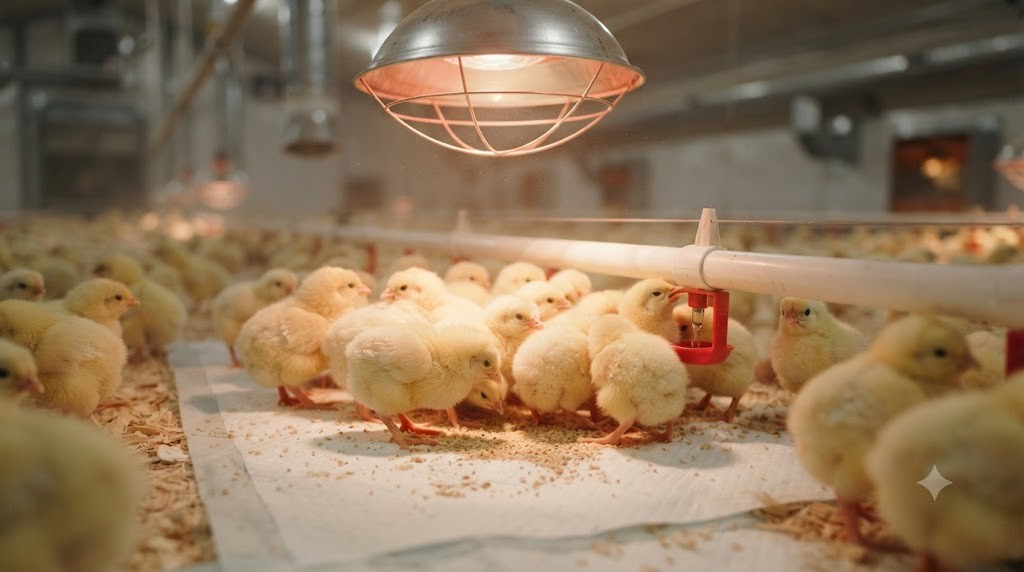
Radiant canopy brooders establish a natural, graduated thermal comfort zone: directly beneath the heater, temperatures are warm (95°F to 100°F), gradually tapering outward to cooler perimeters (86°F). This thermal gradient empowers chicks to self-regulate: individual birds move toward the radiant center when resting, and venture out to feed and drink at cooler margins, mimicking natural brooding beneath a mother hen.
📈
Crop Fill Audits
The 24-Hour Crop Fill Assessment Protocol
The definitive operational test confirming that brooding management is successful is the standardized Crop Fill Assessment. Chicks must locate feed and water immediately upon placement; every hour of delay suppresses lifetime body weight gain.
Step-by-Step Crop Fill Audit Methodology
The farm manager conducts crop fill audits by sampling 100 chicks selected randomly across multiple brooding zones at specific post-placement intervals:
- At 2 Hours Post-Placement: Target >= 75% chicks with full crops.
- At 8 Hours Post-Placement: Target >= 85% chicks with full crops.
- At 24 Hours Post-Placement: Target >= 95% to 98% chicks with full crops.
Palpating the crop provides immediate qualitative feedback:
- Optimal Crop (Soft, Pliant, Dough-Like): Indicates the chick has consumed a balanced mixture of feed crumbles and water. Feed is actively hydrating, and digestion has commenced.
- Hard, Dry Crop: Indicates the chick has consumed feed but has not located water. Feed remains dry and compacted in the crop, predisposing the chick to dehydration and digestive impaction. Water lines are too high, water pressure is excessive, or nipple flow rates are inadequate.
- Watery, Squishy Crop: Indicates the chick has consumed water but cannot find feed. Litter paper coverage is insufficient, or feeder light intensity is too dim.
- Empty Crop: Indicates severe failure; chick is lost, cold, or disoriented.
📈
Feed & Water Engineering
Feed and Water Presentation: Paper Brooding and Flow Rates
Day-old chicks possess poor visual acuity and must be guided directly to nourishment:
Supplementary Feeder Paper Coverage
Automated feeder pans are unfamiliar to young chicks. Modern protocols require rolling out biodegradable kraft paper or textured embossed paper across at least 50% to 75% of the brooding area floor, positioned directly beneath nipple drinker lines. Fresh starter crumbles are distributed generously across the paper (at 50 to 75 grams of feed per chick).
The physical sound of thousands of chicks walking on the crackling paper acts as an auditory stimulant, attracting flock mates to investigate. While walking across the paper, chicks instinctively peck at bright feed crumbles, accelerating immediate feed intake.
Drinker Line Height and Nipple Water Pressure
Drinker height must be adjusted with millimeter precision. On day 1, nipple drinkers must be set at the chicks’ eye level, with water pressure reduced to create a hanging droplet of water on every nipple pin. As chicks grow, drinker lines must be raised daily so that birds drink reaching upward at a 45-degree angle on day 3, progressing to a 60-degree angle by day 7. Reaching upward ensures that water flows directly down the avian esophagus with zero spillage, keeping the brooding litter dry and preventing costly footpad burns.
📈
Air Quality Control
Minimum Ventilation Architecture during Brooding
Heating a brooding barn without proper minimum ventilation creates a lethal environment. While growers are tempted to seal the house tightly to conserve expensive heating gas, a brooding flock produces substantial metabolic moisture, carbon dioxide ($CO_2$), and carbon monoxide ($CO$) from gas combustion heaters.
Minimum ventilation must operate continuously on interval cycle timers (e.g., 60 seconds ON, 240 seconds OFF) independently of temperature thermostats, guaranteeing that:
- Carbon Dioxide ($CO_2$): Remains strictly below 2,500 ppm (never exceeding 3,000 ppm). Elevated $CO_2$ causes chronic lethargy, pulmonary hypertension, and ascites.
- Carbon Monoxide ($CO$): Remains strictly below 10 ppm. $CO$ irreversibly binds avian hemoglobin, causing fatal hypoxia.
- Ammonia ($NH_3$): Remains strictly below 10 to 15 ppm to protect respiratory cilia.
- Relative Humidity: Maintained between 55% and 65% to prevent chick respiratory mucosal dehydration.
By executing flawless thermal pre-heating, achieving 95%+ 24-hour crop fill, providing generous paper feeding, and maintaining uncompromised minimum ventilation air quality, broiler growers establish the golden foundation that guarantees peak flock growth, lowest mortality, and superior commercial processing yields.
📈
Water Chemistry
Water Sanitation Chemistry during Brooding: Oxidation-Reduction Potential (ORP)
While brooder temperature and air quality receive immense management attention, drinking water sanitation during the first 168 hours post-placement is equally decisive. A newly hatched chick’s immune system is naive, and its digestive tract is colonizing rapidly. If drinking water delivers bacterial pathogens, the chick’s mucosal barrier is compromised before it can establish natural protective microflora.
The Oxidation-Reduction Potential (ORP) Standard
Rather than testing water purely for total chlorine parts per million (ppm), modern poultry operations utilize digital Oxidation-Reduction Potential (ORP) millivolt meters. ORP measures the electrical oxidizing capacity of the water—the physical ability of the sanitizer to rupture bacterial cell membranes and oxidize viral capsids.
Target ORP values in poultry drinking water must be maintained between 650 and 750 millivolts (mV) at the furthest nipple drinker from the pump. At an ORP of 650 mV, vegetative bacteria such as Escherichia coli and Salmonella are destroyed in less than 30 seconds. Achieving this ORP requires maintaining water pH between 6.0 and 6.8 (using organic acidifiers) while dosing 2.0 to 4.0 ppm of free available chlorine (as hypochlorous acid, $HOCl$), providing absolute sanitation without irritating delicate chick oral tissues.
📈
Feeder Transitions
Brooding Paper Management and Transition to Automated Pans
The operational transition from temporary paper brooding to exclusive reliance on automated mechanical feeder pans must be carefully managed between days 3 and 7 to prevent digestive disruptions.
Controlled Paper Degradation and Feeder Line Lowering
Modern brooding paper is engineered to naturally degrade under bird foot traffic and moisture over 4 to 5 days. As the paper breaks down, chicks naturally seek alternative feed sources. Farm managers must lower the automated feeder pans directly into the litter on day 3, adjusting pan flooding collars to ensure feed is piled high and visible in every pan.
By day 5, paper feeding is discontinued, and birds transition completely to automated pan augers. If paper is left in the house too long and begins decomposing or accumulating wet manure, bored chicks will consume soiled cellulose fibers, causing mechanical crop impaction and introducing enteric pathogens. Daily litter inspection ensures a smooth, stress-free transition onto automated equipment.
📈
Flock Ethology
Flock Distribution Ethology: Reading Spatial Brooding Patterns
One of the most powerful diagnostic skills of an experienced broiler manager is the ability to read the spatial distribution of the flock across the brooding area. Chicks vote with their feet: their collective physical arrangement across the barn provides an instantaneous visual readout of the thermal microclimate.
Four Classic Brooding Distribution Archetypes
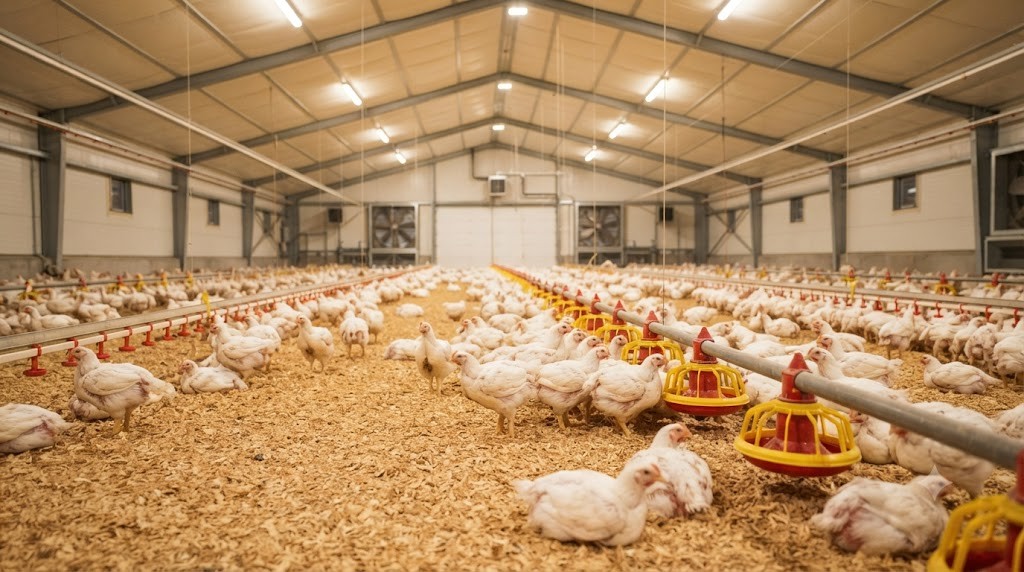
- Optimal Distribution (Evenly Dispersed): Chicks are scattered uniformly across the entire floor area in loose groups. Some are actively feeding at pans, others drinking at nipples, some resting quietly with necks extended on warm litter, and many vocalizing in soft, contented chirps. This confirms ideal floor temperature, air temperature, and air quality.
- Huddling Under Brooders: Chicks crowd tightly together into dense pyramids directly underneath radiant heaters, crying with high-pitched distress chirps. This indicates acute chilling: floor litter temperature is too cold or house heaters are failing.
- Crowding the Outer Perimeters: Chicks flee the center of the brooder ring, pressing tightly against the outer brooder guards or house walls with wings spread open and panting heavily. This indicates dangerous overheating.
- Draft Avoidance (Asymmetrical Grouping): Chicks bunch tightly into an irregular mass on one side of the house while completely avoiding the other side. This reveals a cold draft entering through poorly sealed curtain seams, leaky tunnel doors, or misdirected air inlets.