In the high-density environment of modern commercial broiler production, biosecurity is not a supplementary operational checklist; it is the ultimate structural defense upon which the entire poultry enterprise survives. Housing tens of thousands of birds within a single barn creates an ideal epidemiological ecosystem for explosive pathogen transmission. A single biosecurity breach—allowing the introduction of Highly Pathogenic Avian Influenza (HPAI), virulent Infectious Bronchitis Virus (IBV), or exotic Newcastle Disease—can decimate an entire flock within 48 hours, triggering mandatory regional quarantines, depopulation of hundreds of thousands of birds, and millions of dollars in catastrophic financial losses.
True commercial biosecurity is a comprehensive, multi-tiered containment philosophy encompassing physical barriers, traffic engineering, comprehensive cleaning and chemical disinfection between flocks, targeted hatchery vaccination programs, and continuous vector eradication. This authoritative guide examines the scientific and operational principles required to maintain impenetrable biosecurity defenses across commercial broiler facilities.
📈
Biosecurity Architecture
The Three Pillars of Commercial Poultry Biosecurity
Veterinary epidemiology categorizes poultry biosecurity into three distinct functional zones:
- 1. Conceptual Biosecurity: The foundational strategic decisions regarding farm location and layout. High-standard facilities are sited in geographical isolation, situated at least two miles away from other poultry operations, commercial hatcheries, feed mills, processing plants, and major public highways, completely removed from migratory waterfowl flyways and wetlands.
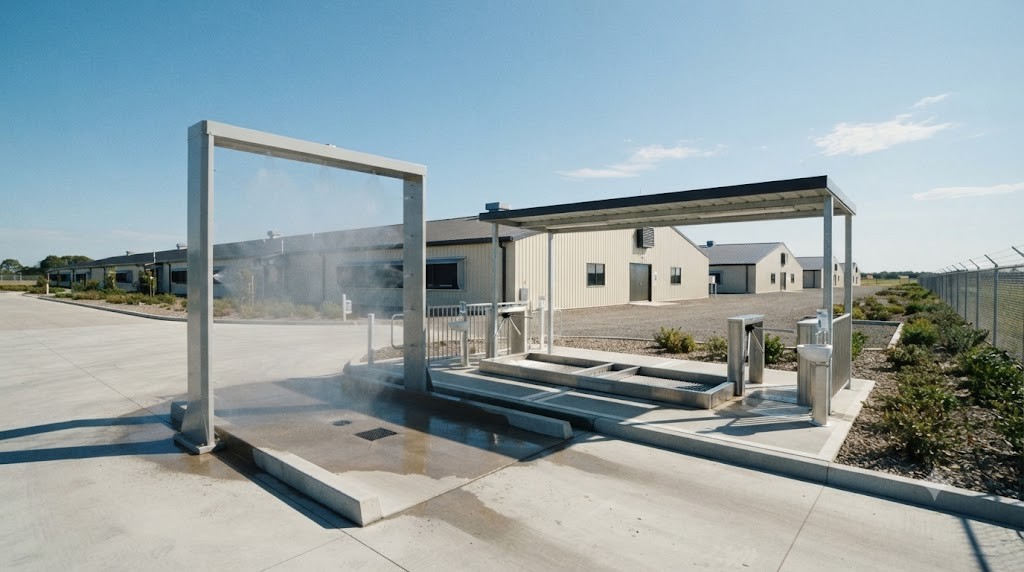
- 2. Structural Biosecurity: The permanent physical infrastructure designed to block pathogen ingress: perimeter security fencing, locked security gates, automated vehicle tire disinfection wash stations, sealed concrete pads, shower-in/shower-out sanitary facilities, bird-proof air inlet netting, and dedicated mortalities disposal infrastructure.
- 3. Operational Biosecurity: The strict, non-negotiable daily management protocols enforced upon farm personnel, service contractors, and visitors: mandatory boot changes, hands sanitization, clean coverall protocols, Danish entry system enforcement, and strict ‘all-in/all-out’ single-age flock management.
| Disinfectant Chemical Class | Active Ingredient Examples | Primary Mechanism of Action | Efficacy Against Organic Matter | Corrosiveness / Safety Profile | Primary Application Zone |
|---|---|---|---|---|---|
| Glutaraldehyde + QAC Blends | Glutaraldehyde + Didecyl dimethyl ammonium chloride | Cross-links proteins; disrupts lipid membranes | Moderate to High | Low corrosive; requires respiratory PPE | Terminal building misting / foaming |
| Peroxygen Compounds | Potassium peroxymonosulfate (Virkon S) | Oxidizes cellular enzymes; destroys nucleic acids | Moderate | Safe on equipment; biodegradable | Boot baths; surface wipe-down; equipment |
| Synthetic Phenolics | Ortho-phenylphenol, Ortho-benzyl-p-chlorophenol | Denatures cellular proteins; cell wall lysis | Very High (Tolerates dirt) | Corrosive; strong residual odor | Concrete slabs; exterior curtain walls |
| Chlorine Dioxide (ClO2) | Stabilized Chlorine Dioxide gas/solution | High-potency oxidation of cell membranes | Low (Requires clean surfaces) | Corrosive to raw steel; exceptional gas diffusion | Water line sanitization; aerial fogging |
| Quaternary Ammonium (QAC) | Benzalkonium chloride (single active) | Disrupts bacterial cytoplasmic membranes | Poor (Inactivated by organic dirt) | Non-corrosive; safe on skin | Clean vehicle tire sprays; hands sanitization |
📈
Sanitary Barriers
The Danish Entry System: The Sacred Line of Separation
The entrance to every commercial poultry barn must be engineered with a standardized Danish Entry System, establishing a physical barrier known as the Line of Separation (LOS):
The Two-Zone Anteroom Architecture
The anteroom is divided into a ‘Dirty Zone’ (exterior world) and a ‘Clean Zone’ (interior barn) physically separated by a solid, sealed 18-inch-high bench spanning the entire width of the room. The protocol proceeds through strict sequential steps:
- Personnel enter the Dirty Zone from outside, remove external footwear, and step onto a rubber sanitation mat.
- Personnel sit on the bench, swing their legs over the physical barrier into the Clean Zone without letting feet touch the Dirty Zone floor, and immediately put on farm-dedicated, color-coded rubber boots located exclusively on the clean side.
- Personnel put on clean, site-dedicated protective coveralls, wash hands with antibacterial soap or alcohol gel (minimum 70% ethanol), step through a secondary disinfectant footbath, and enter the bird housing area.
This simple physical barrier prevents the mechanical tracking of soil, wild bird feces, and virulent virus particles from outside shoes directly onto the clean barn litter.
📈
Turnaround Protocols
Terminal Clean-Out Chemistry and Turnaround Protocols
The turnaround period between harvesting a broiler flock and placing the subsequent flock (typically 10 to 14 days) is the only window in which the microbiological slate of the farm can be wiped completely clean:
1. Total Litter Removal and Dry Cleaning
Immediately upon bird depopulation, the barn must be completely cleared of used litter. Heavy skid loaders remove all manure, shavings, and feathers to an off-site composting location at least one mile away. Personnel then execute a thorough dry clean, blowing down ceiling dust, sweeping walls, and vacuuming feeder lines. Disinfectants cannot penetrate organic matter; applying chemical disinfectants onto dirty, dusty concrete is completely useless.
2. High-Pressure Washing with Alkaline Detergents
Surfaces are pre-soaked with a warm alkaline foam detergent (pH 11 to 12). Alkaline detergents break down lipid grease films, feather dander, and dried proteins that protect bacterial biofilms. After 20 minutes of contact time, surfaces are pressure-washed with hot water (60°C to 70°C at 100 bar pressure), moving systematically from the ceiling apex downward to walls, equipment, and finally the concrete floor.
3. Chemical Disinfection and Terminal Fogging
Once surfaces have fully dried, a certified broad-spectrum disinfectant—ideally a synergistic glutaraldehyde-quaternary ammonium blend—is applied via foaming gun at specified manufacturer dilution rates. After drying, the house is sealed and subjected to thermal fogging with ultra-fine aerosolized disinfectant particles to penetrate inaccessible roof trusses, electrical conduits, and air louvers.
4. The Down-Time Thermal Rest Period
A minimum ‘down-time’ of at least 10 to 14 days must be enforced, during which the empty barn remains locked, sealed, and completely clean. Pathogenic viruses (such as Newcastle and Avian Influenza) and vegetative bacteria naturally die off through environmental desiccation and absence of living avian hosts.
📈
Immunology & Vaccines
Hatchery and Farm Vaccination Programs
Vaccination programs provide critical immunological shields against ubiquitous poultry pathogens. In modern integrated broiler production, vaccination begins before the chick even hatches:
In-Ovo Vaccination at Day 18 of Incubation
Automated in-ovo injection machines (such as Embrex Inovoject) penetrate fertile hatching eggs at day 18 of incubation during transfer from setter to hatcher. Precision needles deliver vaccines—most notably for Marek’s Disease (HVT vector vaccines) and Infectious Bursal Disease (Gumboro)—directly into the amniotic fluid or developing embryo body. In-ovo vaccination guarantees 100% flock coverage, eliminates human injection errors, and establishes robust active immunity days before chicks are placed on farm litter.
Hatchery Spray Cabinet Vaccination
Upon hatching, day-old chicks pass through automated spray cabinets that deliver coarse droplet vaccines for Newcastle Disease and Infectious Bronchitis Virus (IBV). Chicks inhale droplets and ingest vaccine particles while preening, inducing rapid mucosal IgA antibody synthesis across the respiratory tract within days of life.
📈
Vector Eradication
Integrated Pest Management: Rodents, Darkling Beetles, and Wild Birds
Biological vectors are insidious biological couriers of avian disease:
Darkling Beetles (Alphitobius diaperinus)
The lesser mealworm/darkling beetle is the scourge of commercial broiler housing. Beetles harbor and transmit lethal pathogens including Salmonella, E. coli, Campylobacter, Infectious Bursal Disease Virus, and reoviruses. When barns are depopulated and cool down, beetle larvae burrow into wall insulation, destroying expensive thermal building materials. Applying residual chemical insecticides (pyrethroids, spinosad, or insect growth regulators [IGRs]) to floor-wall junctions within hours of bird harvest, while the litter is still warm, effectively breaks beetle reproductive cycles.
Rodent Control Architectures
Rats and mice are primary vectors for Salmonella enterica serovars. An adult rat can consume or contaminate hundreds of pounds of feed per month. Commercial farms maintain a three-tier rodent perimeter: tamper-proof bait stations spaced every 40 to 50 feet along the external security fence, a second ring along the exterior barn walls, and mechanical traps inside anterooms, deploying rotated anticoagulant rodenticides to prevent chemical resistance.
By enforcing uncompromising physical barriers, executing rigorous terminal cleaning chemistry, deploying precision in-ovo vaccines, and aggressively eradicating biological vectors, commercial poultry managers construct an impenetrable fortress of biosecurity, safeguarding flock health, animal welfare, and the long-term financial viability of the enterprise.
📈
Mortality Management
Mortality Disposal Engineering: Aerobic Thermophilic Composting
Every commercial poultry operation inevitably experiences natural baseline mortality (typically 2% to 4% over a 35-day grow-out). How dead birds are handled and disposed of is one of the most critical biosecurity vectors on the farm. Discarding carcasses in open pits attracts scavengers, buzzards, coyotes, and flies that mechanically transport lethal pathogens to neighboring farms.
The Biology of On-Farm Mortality Composting
Modern poultry biosecurity mandates closed-structure, multi-bin aerobic thermophilic composting. Carcasses are layered into concrete-walled bins alternating with carbon-rich sawdust, wood shavings, or straw at a strict Carbon-to-Nitrogen (C:N) ratio of 25:1 to 30:1, with moisture maintained at 50% to 60%.
Within 48 to 72 hours, thermophilic bacteria (predominantly Bacillus and Actinobacteria) proliferate, driving internal core pile temperatures up to 130°F to 150°F (55°C to 65°C). Sustained exposure to these high temperatures completely pasteurizes pathogenic bacteria and enveloped viruses (including Avian Influenza and Newcastle Disease virus) within days. After two successive heating cycles and managed aeration turns, carcasses are fully converted into rich, sterile, odorless organic humus that can be safely applied as agronomic fertilizer.
📈
Water Line Sanitation
Water Line Biofilm Remediation and Chemical Descaling Protocols
During the flock down-time period, water distribution systems require aggressive chemical cleaning. Enclosed plastic nipple drinker lines provide an ideal dark, warm environment for stubborn microbial biofilms—complex matrix polysaccharides secreted by Pseudomonas, iron bacteria, and coliforms that adhere tenaciously to pipe interiors.
The Two-Step Descaling and Disinfection Protocol
Standard chlorine sanitizers cannot penetrate established biofilms. Modern down-time remediation requires a two-step chemical protocol:
- Step 1 (Acid Descaling): Pumping a 1% to 2% solution of citric acid or inorganic sulfamic acid through the lines to dissolve inorganic calcium scale, iron oxides, and manganese mineral crusts that anchor biofilms to PVC pipe walls.
- Step 2 (Hydrogen Peroxide / Peracetic Acid Shock): Charging the lines with a 2% to 3% stabilized hydrogen peroxide ($H_2O_2$) or peracetic acid (PAA) solution, holding it in the lines for 12 to 24 hours. The aggressive bubbling effervescence physically strips biofilm matrices from pipe walls, oxidizing all encapsulated pathogens.
Lines are subsequently flushed with high-pressure clean water until all loosened slime is discharged through terminal drain valves. ATP bioluminescence swab testing of nipple interiors confirms zero microbial residue before placing new chicks.
📈
Perimeter Biosecurity
Vehicle Decontamination Arches and Feed Truck Biosecurity
Commercial feed delivery trucks, litter haulers, and live-haul catching trailers represent the highest-risk mechanical fomites entering a poultry farm. A feed truck visits multiple farms every day, traversing public roadways contaminated with wild bird feces and livestock debris.
Automated Drive-Through Spray Arch Architecture
Advanced biosecurity installations require all vehicles to pass through an automated concrete wash station at the farm perimeter gate. Optical sensors trigger high-pressure pump arrays delivering broad-spectrum disinfectant spray arches. The system must incorporate:
- Underbody Chassis Nozzles: High-impact rotating turbo nozzles recessed into the concrete slab that blast road dirt, mud, and manure from the vehicle undercarriage and axles.
- Tire Immersion Wells: Deep tire baths ensuring complete 360-degree contact around large commercial truck tires.
- Driver Cab Protocols: Truck drivers must remain inside the vehicle cab during feed unloading, or put on farm-dedicated disposable plastic boot covers before stepping onto the concrete pad.
📈
Water Purification
Ultraviolet (UV) Water Purification Arrays
Where farm water is drawn from open surface reservoirs or shallow groundwater wells vulnerable to seasonal run-off contamination, chemical sanitizers are reinforced with in-line Ultraviolet (UV) disinfection systems. Water passes through stainless steel chambers containing high-output germicidal mercury vapor lamps emitting monochromatic UV-C radiation at 254 nanometers.
A UV dose of 30 to 40 millijoules per square centimeter ($mJ/cm^2$) penetrates bacterial and viral cell walls, cross-linking thymine bases in microbial DNA and rendering pathogens permanently sterile and incapable of replication. Pre-filtering water through 5-micron sediment cartridges ensures zero particulate turbidity, guaranteeing maximum UV light transmission and pristine drinking water delivery to the flock.