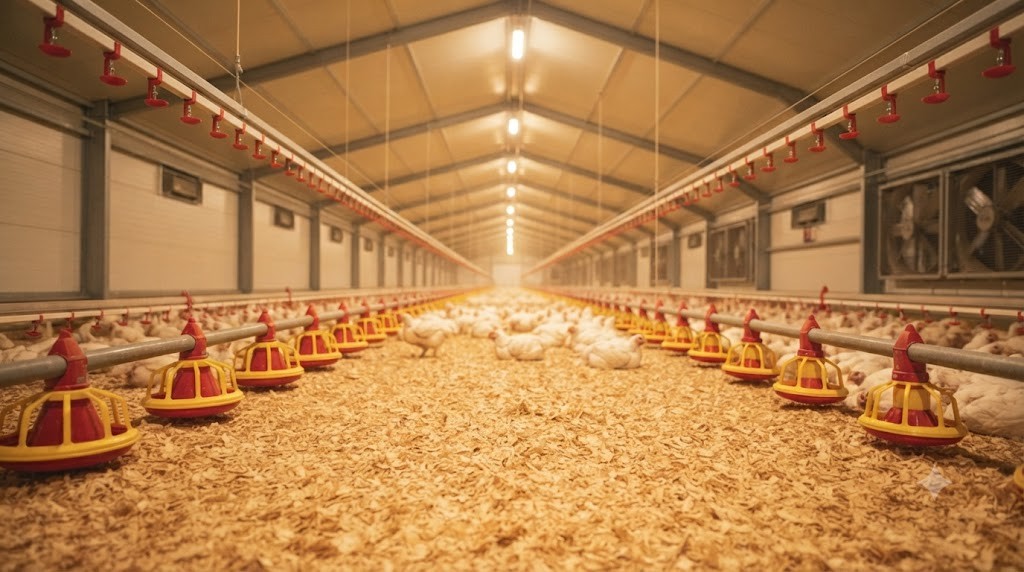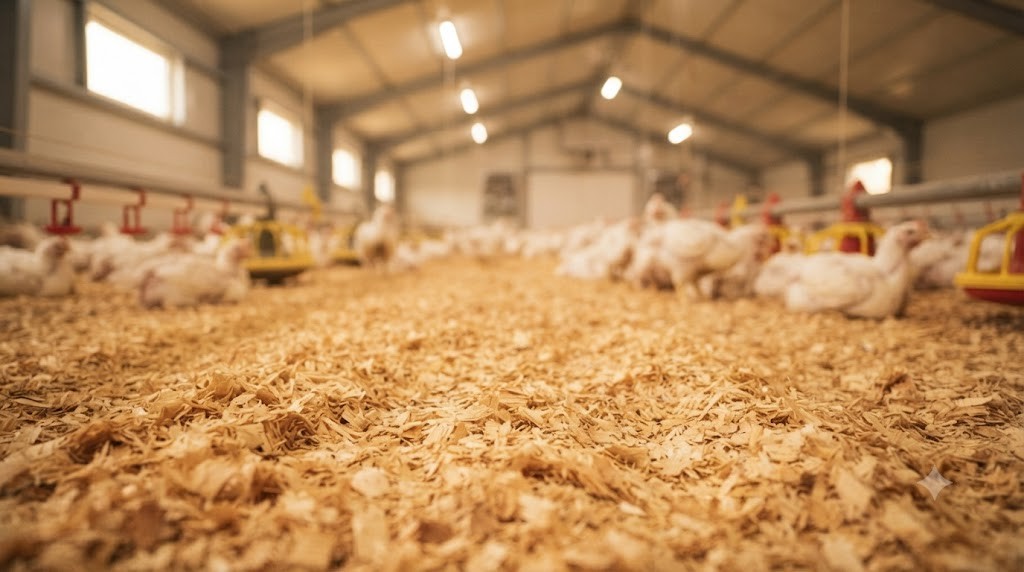
In floor-housed commercial broiler and turkey production, the floor litter pack is not merely an inert bedding material; it is a dynamic, biologically active microbiological ecosystem with which the birds remain in continuous, direct physical contact throughout their entire lives. The condition of the litter directly governs bird health, paw quality, respiratory integrity, feed conversion efficiency, and food safety. Poorly managed litter—characterized by excessive moisture accumulation, caking, and elevated ammonia volatilization—is the primary environmental vector driving footpad dermatitis, hock burns, breast blisters, airsacculitis, and high processing plant downgrades.
Maintaining high-quality litter requires managing a delicate biochemical equilibrium. Broiler chickens excrete nitrogenous wastes predominantly as uric acid. When uric acid encounters moisture, warmth, and bacterial urease enzymes naturally present in poultry manure, it undergoes rapid microbial decomposition, releasing pungent, toxic gaseous ammonia ($NH_3$). Controlling this process demands deep agronomic comprehension of bedding material physics, moisture absorption thresholds, chemical litter acidifiers, and in-house windrow composting protocols.
🏡
Ammonia Chemistry
The Chemistry of Ammonia Volatilization in Poultry Litter
Gaseous ammonia production is driven by enzymatic and microbial degradation of excreted nitrogen. The primary biochemical pathway follows two sequential microbial reactions:
- 1. Uric Acid Hydrolysis: Uric acid is broken down into urea by microbial uricase enzymes:
Uric Acid + O2 + H2O -> Allantoin -> Urea
- 2. Urea Hydrolysis (The Urease Reaction): Bacterial urease enzymes rapidly hydrolyze urea into gaseous ammonia and carbon dioxide:
(NH2)2CO + H2O -> 2 NH3 (Gas) + CO2
The Critical Roles of Litter pH, Moisture, and Temperature
The rate of ammonia volatilization is governed almost entirely by three environmental triggers:
- Litter pH: Ammonia exists in poultry litter in chemical equilibrium between volatile uncharged ammonia gas ($NH_3$) and non-volatile ammonium ions ($NH_4^+$). At a litter pH below 7.0 (acidic), virtually all ammonia is chemically converted into stable ammonium ions, which remain bound in the litter. However, fresh poultry manure has a natural alkaline pH of 7.5 to 8.5. At a pH above 8.0, the equilibrium shifts dramatically, converting ammonium ions into volatile gaseous $NH_3$ that surges into the air.
- Litter Moisture: Moisture is the essential catalytic solvent. Bacterial urease enzymes require water to function. At litter moisture levels below 20%, bacterial enzyme activity is essentially dormant. However, when moisture rises between 25% and 40%, ammonia generation accelerates exponentially.
- Litter Temperature: Urease enzyme kinetics double with every 10°C (18°F) rise in litter temperature, explaining why brooding houses heated to 90°F release suffocating surges of ammonia if moisture is present.
| Atmospheric Ammonia Level | Avian Physiological Impact | Clinical Pathology | Commercial Performance Loss | Action Threshold |
|---|---|---|---|---|
| 0 – 10 ppm | Optimal physiological baseline | Intact tracheal cilia; normal mucus clearance | None; optimal FCR and growth velocity | Target operating standard |
| 11 – 20 ppm | Subclinical respiratory irritation | Mild goblet cell hyperplasia; slight mucus increase | 0.5 – 1.0 point FCR penalty; slight vaccine reactions | Increase minimum ventilation |
| 21 – 50 ppm | Severe mucosal paralysis (Ciliostasis) | Complete loss of tracheal cilia; bacterial colonization | 2 – 5 points FCR loss; severe vaccine breaks (IBV/ND) | Immediate emergency ventilation; acidify litter |
| > 50 ppm | Corneal ulceration & blindness (Keratoconjunctivitis) | Corneal opacity; severe photophobia; respiratory necrosis | Catastrophic mortality; flock blindness; extreme condemnation | Immediate structural intervention required |
🏡
Bedding Materials
Bedding Material Physics: Pine Shavings, Rice Hulls, and Peanut Shells
The physical properties of the chosen bedding material dictate its water absorption capacity, drying rate, and friability:
1. Kiln-Dried Pine Shavings: The Industry Gold Standard
Softwood pine shavings (specifically kiln-dried yellow pine or white pine) remain the premier bedding substrate globally. Softwood shavings possess a porous cellular microstructure that absorbs roughly 2.5 to 3.0 times their dry weight in water. They contain natural balsamic terpenes that exert mild antibacterial properties against Salmonella and Staphylococcus, and their flat, soft particle geometry prevents footpad abrasion.
Critically, hardwood shavings (such as oak, cherry, or walnut) must never be used in poultry barns. Hardwood shavings frequently contain high concentrations of tannins that stain poultry skin, and are notorious for harboring spores of the fungus Aspergillus fumigatus, which causes fatal mycotic brooder pneumonia (aspergillosis) in young chicks.
2. Rice Hulls: Excellent Friability and Low Caking
In rice-growing regions of the American South and Southeast Asia, parboiled or raw rice hulls are widely utilized. While rice hulls absorb slightly less total water by weight than pine shavings (approximately 1.8 to 2.2 times dry weight), they exhibit outstanding physical friability. Rice hulls resist compaction, allowing birds to scratch and churn the litter easily, which accelerates moisture evaporation and prevents dense surface crusting.
3. Peanut Hulls and Chopped Straw
Peanut hulls provide good absorption, but must be screened to remove fine dust, which causes respiratory irritation. Wheat straw and oat straw are widely available but require mechanical chopping (to lengths between 1 and 2 inches) prior to placement; whole long straw packs into dense, impenetrable mats that quickly cake into wet, slippery sheets over the floor.
🏡
Litter Acidifiers
Chemical Litter Acidifiers: Pre-Brooding Application Science
In operations that reuse litter packs across multiple flocks—a standard economic practice across North America—applying dry chemical litter acidifiers prior to chick placement is the primary defense against early-flock ammonia spikes.
Sodium Bisulfate (PLT – Poultry Litter Treatment)
The most widely deployed commercial litter acidifier is dry granular sodium bisulfate ($NaHSO_4$). When sodium bisulfate is broadcast onto damp poultry litter, it dissolves in surface moisture, dissociating into sodium ions, sulfate ions, and hydrogen ions ($H^+$):
NaHSO4 + H2O -> Na+ + SO4(2-) + H+ (Acid)
The surge of hydrogen ions drives the surface litter pH down from an alkaline 8.5 to an ultra-acidic 1.5 to 2.0. This dramatic acidification accomplishes two vital biological functions:
- Complete Ammonia Trapping: At a pH of 2.0, all volatile ammonia gas is instantly protonated into non-volatile ammonium ($NH_4^+$), chemically locking it into the litter as stable ammonium sulfate fertilizer. Atmospheric ammonia in the house plummets to near zero for 10 to 21 days during the critical brooding window.
- Bactericidal Pathogen Kill: The extreme acidity ruptures bacterial cell membranes, slashing populations of Salmonella, Campylobacter, E. coli, and Clostridium perfringens on the floor litter before day-old chicks arrive.
🏡
Paw Quality
Footpad Dermatitis (FPD) and Paw Quality Economics
In international commercial poultry trade, chicken paws (processed feet) represent the third most lucrative economic component of the carcass, following breast meat and wings. High-grade, unblemished paws command immense price premiums in Asian export markets (particularly China and Hong Kong).
The Pathogenesis of Footpad Lesions
Footpad dermatitis (FPD), commonly termed bumblefoot or paw burns, begins when litter moisture exceeds 30% to 35%. Wet litter cakes into dense, clay-like mats beneath drinker lines and feeder tracks. The combination of wet moisture, high friction, and caustic alkaline chemical salts in poultry manure erodes the delicate keratinized stratum corneum of the chick’s footpads.
Within days, superficial erosion progresses to deep necrotic ulcerations, characterized by dark brown and jet-black lesions. Bacteria (specifically Staphylococcus aureus and E. coli) invade the open lesions, causing systemic abscesses, joint infections (tenosynovitis), severe lameness, and complete condemnation of the paws at the processing plant. Maintaining litter moisture strictly between 20% and 25% is the single most effective guarantee of pristine paw quality.
🏡
Windrow Composting
In-House Windrow Composting during Turnaround
When reusing litter across consecutive flocks, farm operators execute in-house windrow composting during the 10- to 14-day down-time period between flocks:
The Windrowing Protocol
Immediately upon bird depopulation, tractors equipped with front-end loaders or specialized windrowing plows push all floor litter into long, continuous trapezoidal piles (windrows) running down the length of the barn (typically 4 to 6 feet high and 8 to 10 feet wide). Piling the litter traps metabolic heat and introduces oxygen.
Within 24 to 48 hours, aerobic thermophilic bacteria proliferate, driving internal core pile temperatures up to 130°F to 150°F (55°C to 65°C). Holding the windrows at these high temperatures for at least 72 hours completely pasteurizes lethal avian viruses (including Avian Influenza, Gumboro, and Reoviruses) and destroys vegetative pathogenic bacteria. The piles are subsequently turned with compost turners to aerate the outer layers, rested for another 48 hours, and then leveled back across the floor and allowed to cool and dry before new chicks arrive.
By integrating high-quality bedding substrates, precision minimum ventilation, chemical litter acidifiers, and rigorous in-house windrowing composting, poultry producers conquer ammonia challenges, protect bird respiratory health, eliminate footpad lesions, and maximize commercial broiler enterprise profitability.
🏡
Moisture Testing
Litter Moisture Measurement Protocols: Analytical vs. Field Tests
Precise litter management requires objective, routine quantification of moisture content rather than subjective guesswork. Farm managers utilize two standardized testing methods:
The Laboratory Gravimetric Drying Protocol
The scientific benchmark is the gravimetric oven-drying assay. Representative 100-gram litter samples are gathered across multiple house locations (away from drinker drips). Samples are weighed on an analytical balance, placed in a forced-air drying oven at 105°C (221°F) for 24 hours until all moisture evaporates, and re-weighed. Moisture percentage is calculated directly as:
Litter Moisture (%) = [ (Wet Weight – Dry Weight) / Wet Weight ] * 100
The Practical On-Farm Hand-Squeeze Field Test
In daily house management, growers execute the classic ‘ball squeeze test’:
- Optimal Litter (20% to 25% Moisture): Squeezing a handful of litter firmly in your fist forms a loose ball that adheres momentarily, but gently crumbles apart when tapped or released. Footprints on the litter surface leave shallow indentations that naturally rebound.
- Excessively Wet Litter (> 35% Moisture): Squeezing the litter leaves a dense, compacted mud ball that stays rigidly formed. Surface moisture clings to the palm of the hand. Litter cakes into hard surface crusts, demanding immediate de-caking machine intervention.
- Excessively Dry Litter (< 18% Moisture): The litter cannot form a ball at all and crumbles into powdery dust. Dry litter generates extreme airborne particulate dust, irritating chick respiratory passages.
🏡
Biological Control
Botanical Saponins and Microbial Inoculants for Ammonia Suppression
In addition to mineral acidifiers, modern sustainable poultry production deploys natural biological and botanical feed additives that suppress ammonia volatilization directly at the metabolic level:
Yucca Schidigera Botanical Saponins
Extracts derived from the desert plant Yucca schidigera contain dense concentrations of steroid saponins and glycocomponents. When incorporated into broiler rations (at 60 to 120 ppm), yucca saponins bind directly to free ammonia molecules in the digestive tract, preventing them from volatilizing into gas. Furthermore, yucca extracts inhibit microbial urease enzymes in the cecal digesta, reducing fecal ammonia output by up to 30% before manure is even deposited on the floor.
Live Beneficial Microbial Litter Inoculants
Growers frequently spray damp litter packs with concentrated inoculants containing selected strains of beneficial nitrifying bacteria (such as Nitrosomonas and Nitrobacter) and lactic acid bacteria. These beneficial organisms outcompete wild urease-producing bacteria, rapidly converting volatile ammonia into stable nitrates and organic nitrogen, creating a biologically stable litter environment.
🏡
Beetle Remediation
Darkling Beetle Eradication and Litter Chemistry Synergy
The lesser mealworm or darkling beetle (Alphitobius diaperinus) is intimately tied to litter ecology. As the litter pack ages across multiple flocks, beetle populations can explode into millions of insects per house. Beetles consume expensive poultry feed, transmit viral and bacterial pathogens, and burrow into rigid polyurethane wall insulation, destroying the building’s thermal R-value.
Rotational Insecticide Chemistry at De-Caking
Controlling darkling beetles requires integrating mechanical litter management with rotational chemical applications. Immediately following bird harvest, while the litter remains warm, managers spray the litter-wall junctions and lower 3 feet of sidewall posts with rotated chemical classes: alternating between synthetic pyrethroids (such as lambda-cyhalothrin), spinosad, and insect growth regulators (IGR pyriproxyfen). Applying granular boric acid into the floor-wall cracks creates an abrasive, toxic barrier that halts beetle larvae before they can pupate in the soil.