Phase feeding is the operational cornerstone of modern poultry diet formulation. As domestic poultry grow and develop from newly hatched day-old chicks into market-ready broilers or mature ovipositing layers, their metabolic demands, digestive tract enzyme capacities, and somatic growth curves undergo continuous transformation. Supplying a single static diet throughout a bird’s lifespan is biologically inefficient and financially unsustainable: it severely undernourishes young chicks during rapid organogenesis and wastefully oversupplies expensive protein to older birds.
Through phase feeding, commercial poultry operations divide the production lifecycle into discrete feeding intervals—typically Starter, Grower, Finisher, and Withdrawal phases for meat birds, or Starter, Grower, Developer, and Pre-Lay phases for replacement pullets. Each phase is formulated with precise nutrient density designed to match the flock’s changing physiological trajectory, maximizing growth velocity and feed conversion efficiency while minimizing input costs.
🌾
Phase Physiology
The Physiological Foundations of Avian Phase Feeding
To grasp why nutritional requirements shift so dramatically across phases, one must examine the developmental biology of the growing chicken.
The Critical First Week: Gastrointestinal and Immune Development
At hatch, the day-old chick undergoes a monumental metabolic transition: it shifts from utilizing the lipid-rich internal yolk sac as an endogenous nourishment source to digesting complex exogenous solid feedstuffs. During the first 7 to 10 days of life, the chick’s gastrointestinal tract and immune organs (the bursa of Fabricius and thymus) develop at a relative growth rate that is two to three times faster than somatic muscle tissue.
However, the young chick’s digestive physiology is enzymatically immature. Secretions of pancreatic lipase, trypsin, amylase, and hepatic bile salts are minimal at hatch, gradually increasing to mature concentrations over the first 14 days. Consequently, chick starter rations must prioritize exceptionally digestible raw ingredients, balanced amino acid profiles, and moderate lipid levels to foster rapid intestinal villi elongation and nutrient absorptive capacity.
Muscle Deposition vs. Maintenance Energy Shifts
As the bird progresses into the grower and finisher periods, the relative growth rate of internal organs decelerates while skeletal muscle accretion and adipose tissue deposition accelerate. Simultaneously, because total body mass increases four-fold to six-fold, the bird’s basal metabolic maintenance energy requirement expands dramatically.
Consequently, the ideal protein-to-energy ratio in the diet naturally declines over time:
- Starter Phase (High Protein, Moderate Energy): Prioritizes high concentrations of digestible amino acids (22% to 24% CP in broilers) to support organogenesis, immune development, and skeletal elongation, paired with moderate energy (3,000 kcal/kg AMEn).
- Grower Phase (Balanced Protein and Energy): Moderates crude protein (20% to 21% CP) while increasing energy density (3,100 kcal/kg AMEn) to sustain peak lean muscle deposition.
- Finisher Phase (Low Protein, High Energy): Reduces crude protein (18% to 19% CP) and elevates energy density (3,200 to 3,250 kcal/kg AMEn) via supplemental fats, satisfying elevated maintenance energy demands while finishing carcass weight.
| Production Phase | Age Window | Crude Protein (%) | AMEn (kcal/kg) | SID Lysine (%) | Ca (%) | Avail P (%) | Physical Feed Form |
|---|---|---|---|---|---|---|---|
| Pre-Starter | Day 0 – 7 | 23.0 – 24.5% | 2,950 – 3,025 | 1.32 – 1.40% | 1.00% | 0.50% | Fine Sifted Crumble |
| Broiler Starter | Day 8 – 21 | 21.5 – 23.0% | 3,025 – 3,100 | 1.20 – 1.28% | 0.95% | 0.45% | Crumbled Pellets |
| Broiler Grower | Day 22 – 35 | 19.5 – 21.0% | 3,125 – 3,175 | 1.05 – 1.12% | 0.85% | 0.40% | 3 mm Pellets |
| Broiler Finisher | Day 36 – Market | 17.5 – 19.0% | 3,175 – 3,250 | 0.92 – 1.00% | 0.78% | 0.35% | 3.5 – 4 mm Pellets |
| Pullet Starter | Week 0 – 6 | 19.0 – 20.5% | 2,850 – 2,925 | 1.00 – 1.08% | 1.00% | 0.45% | Mash or Crumble |
| Pullet Grower | Week 7 – 14 | 15.0 – 16.5% | 2,750 – 2,825 | 0.72 – 0.78% | 0.90% | 0.38% | Coarse Mash |
| Pullet Developer | Week 15 – 18 | 14.0 – 15.0% | 2,700 – 2,775 | 0.62 – 0.68% | 1.20% | 0.35% | Coarse Mash |
🌾
Ingredients & Quality
Core Raw Material Characterization and Processing
Precision feed formulation requires an intimate understanding of the physical, chemical, and nutritional attributes of primary raw materials.
Cereal Grains: Corn, Wheat, and Sorghum
Cereal grains represent the predominant energy fraction of poultry diets, contributing 60% to 70% of total ration weight. Yellow dent corn (maize) is the gold standard globally due to its exceptional starch digestibility, high AMEn (approximately 3,350 kcal/kg), low fiber content (under 2.5%), and natural xanthophyll carotenoids that impart golden yellow coloration to chicken skin and egg yolks.
In regions where wheat is economically preferred (such as Canada, Europe, and Australia), diets require careful enzyme supplementation. Wheat contains significant concentrations of non-starch polysaccharides (NSPs), specifically soluble arabinoxylans. These soluble fibers absorb water in the avian small intestine, forming viscous gels that slow digesta transit, trap digestive enzymes, and cause sticky, wet droppings. Adding exogenous endo-beta-xylanase enzymes to wheat-based diets hydrolyzes these arabinoxylan polymers, slashing intestinal viscosity and recovering lost energy value.
Protein Meals: Soybean Meal, Canola, and Animal Byproducts
Dehulled solvent-extracted soybean meal (SBM, 48% CP) is the undisputed premier vegetable protein source in poultry nutrition, boasting an exceptional amino acid concentration and superior digestibility, especially for lysine. However, raw soybeans contain potent anti-nutritional factors, including Kunitz and Bowman-Birk trypsin inhibitors and lectins, which inhibit pancreatic protein digestion and induce pancreatic hypertrophy.
Proper hydrothermal processing during oil extraction denatures these heat-labile trypsin inhibitors. Feed mills strictly monitor processing quality using assays such as Urease Activity (optimal range 0.05 to 0.20 delta pH) and Potassium Hydroxide (KOH) Protein Solubility (optimal range 78% to 84%). Canola meal and sunflower meal serve as viable secondary protein sources, but higher fiber content and lower lysine concentrations require careful reformulation.
🌾
Milling Technology
Particle Size Dynamics and Milling Technology
The physical particle size distribution of ground grains profoundly dictates avian gastrointestinal development and motility. Chickens are evolutionary grain eaters possessing a highly muscular stomach organ: the gizzard (ventriculus).
Gizzard Development and Reverse Peristalsis
Feeding excessively fine-ground powdery feed (geometric mean diameter under 500 microns) causes the avian gizzard to become flaccid, underdeveloped, and hypotrophic. Without coarse particles to grind, the gizzard fails to develop muscular strength, digesta transit accelerates prematurely, and the secretion of hydrochloric acid and pepsinogen in the proventriculus declines, elevating proventricular pH.
Conversely, maintaining a coarse grind (geometric mean diameter between 800 and 1,100 microns) stimulates vigorous gizzard muscular contractions, increases organ mass by up to 40%, and promotes gastroduodenal reverse peristalsis (reflux). This physiological reflux repeatedly bathes digesta in gastric secretions and bile acids, significantly boosting protein digestibility, reducing pathogenic bacterial colonization in the small intestine, and improving flock feed conversion ratios.
Roller Mills vs. Hammer Mills
Feed mills utilize two primary milling technologies to grind raw grains:
- Hammer Mills: Impact raw grain kernels with high-velocity rotating steel beaters against a perforated screen. While hammer mills deliver high throughput, they generate wide particle size variations with high percentages of unwanted fine dust.
- Roller Mills: Shear grain kernels between pairs of counter-rotating cylindrical rolls with specialized fluting. Roller mills produce a highly uniform, rectangular particle geometry with minimal fine dust, providing optimal particle size consistency for poultry gizzard stimulation.
🌾
Pelleting Science
Conditioning and Steam Pelleting Engineering
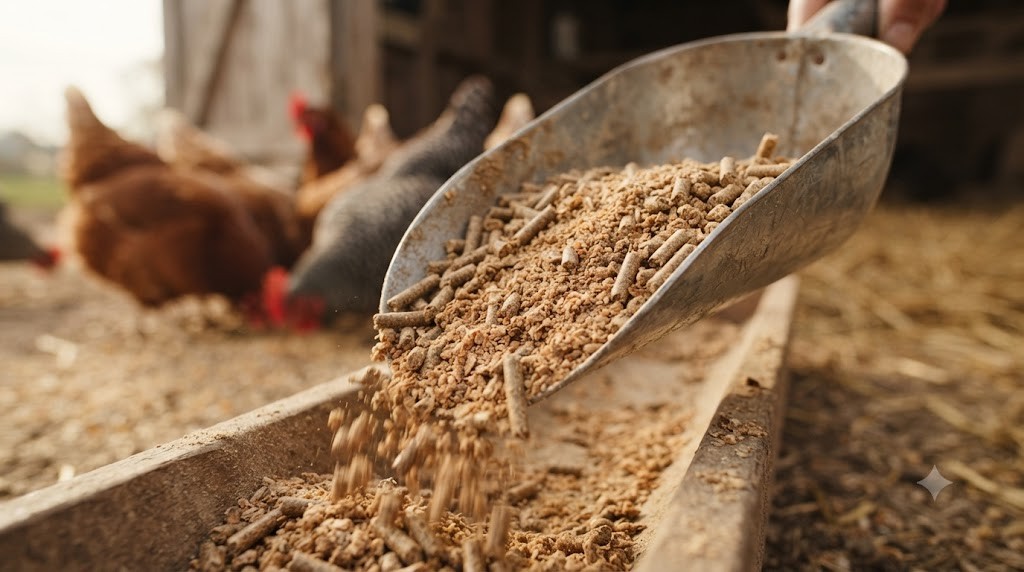
Pelleting transforms a ground mash formula into dense, cylindrical feed pellets through the combined application of moisture, heat, and mechanical compression:
Thermal Conditioning and Starch Gelatinization
Prior to entering the pellet die, mash passes through a continuous thermal conditioner where live dry steam (at 1.5 to 2.5 bar pressure) is injected, elevating mash temperature to 80°C to 88°C with moisture reaching 15% to 17%. Steam conditioning performs three essential functions:
- Starch Gelatinization: Partially gelatinizes cereal starches, breaking crystalline amylose and amylopectin bonds and transforming starch into a natural binding glue that confers structural hardness to pellets.
- Pathogen Decontamination: Sustained exposure to high conditioning temperatures provides effective thermal pasteurization, eliminating vegetative foodborne pathogens such as Salmonella enterica and pathogenic E. coli.
- Anti-Nutritional Inactivation: Inactivates residual heat-labile enzyme inhibitors and improves amino acid bioavailability.
Pellet Durability Index (PDI)
Pellet quality is quantified at the mill using the Pellet Durability Index (PDI), measured via the Holmen tester or tumbling box assay. A high-performing broiler operation demands a PDI exceeding 88% to 92%. When fragile pellets fracture into fines during pneumatic transport, silo unloading, and auger feeding, bird performance deteriorates rapidly. Field research demonstrates that for every 10% increase in feed fines, broiler feed conversion ratio worsens by 1.5 to 2.0 points, as birds expend excessive physical energy pecking at fine particles.
🌾
Formulation Science
Least-Cost Formulation Software and Linear Programming
Modern feed formulation is executed using specialized linear programming software (such as Concept5, Bestmix, or Format). The software solves complex mathematical equations to identify the lowest-cost combination of available raw ingredients that completely satisfies an extensive matrix of nutritional constraints.
Establishing Nutritional Shadow Prices and Bounds
In linear formulation, nutritionists assign strict upper and lower bounds for nutrients and ingredients. For example, a formulation might stipulate: ‘Crude protein >= 20.0%’, ‘SID Lysine >= 1.15%’, ‘Available Phosphorus between 0.42% and 0.45%’, and ‘Distillers Dried Grains with Solubles (DDGS) <= 8.0%'.
The mathematical output delivers not only the final diet recipe and cost per ton, but critical economic metrics known as ‘shadow prices’. A shadow price reveals the exact price reduction required for an excluded ingredient to enter the formula, or conversely, how much the overall ration cost would increase if a specific nutrient constraint is made more stringent.
By harmonizing phase feeding physiology with rigorous raw material quality control, least-cost computer optimization, coarse milling technology, and high-standard steam pellet manufacturing, poultry farm managers achieve the highest possible return on their single largest operating investment: feed.
🌾
Quality Control
Near-Infrared Reflectance (NIR) Spectroscopy in Feed Quality Control
The speed and accuracy of raw material analytical testing in commercial feed mills have been revolutionized by Near-Infrared Reflectance (NIR) spectroscopy. In high-capacity feed mills processing thousands of metric tons of grain each week, traditional wet chemistry assays (such as Kjeldahl nitrogen determination, Soxhlet fat extraction, and classical bomb calorimetry) are too slow, requiring 24 to 48 hours for laboratory results—long after grain has already been unloaded into silos and mixed into finished rations.
Real-Time In-Line Ingredient Profiling
Modern feed processing plants deploy in-line and benchtop NIR spectrophotometers that scan incoming grain shipments within 60 seconds. By measuring the reflectance of infrared light across specific molecular vibration wavelengths (such as C-H, N-H, and O-H bonds), NIR instruments calculate exact moisture, crude protein, crude fat, crude fiber, ash, and standardized ileal digestible amino acid concentrations with extraordinary precision.
This rapid analytical capability allows feed mill nutritionists to execute dynamic matrix adjustments. If an incoming shipment of soybean meal tests at 46.2% crude protein rather than the contracted 48.0% baseline, the formulation software instantly updates the active batching matrix in real time, automatically compensating by slightly increasing soybean meal inclusion and adjusting synthetic amino acid additions to ensure that the finished broiler feed never leaves the mill deficient in essential nutrients.
🌾
Storage Engineering
Feed Storage Biosecurity, Aeration, and Mold Prevention
The nutritional value of a meticulously formulated poultry ration can be entirely destroyed during on-farm bulk storage if environmental and physical storage parameters are neglected. Galvanized steel feed silos on poultry farms are subjected to intense diurnal temperature fluctuations, creating severe condensation hazards.
Thermal Siphoning and Moisture Migration
During warm sunny days, radiant solar heat warms the steel walls of the silo and the outer layer of stored feed. At night, ambient air temperatures plunge, rapidly cooling the silo walls. This temperature differential sets up internal convective air currents (thermal siphoning): warm moist air within the core of the feed mass rises toward the apex of the bin, where it contacts the cold steel roof, condenses into liquid water droplets, and drips down onto the top layer of feed.
This localized moisture accumulation creates an ideal breeding ground for toxigenic storage molds, predominantly Aspergillus flavus and Penicillium species. Within days, fungal colonies proliferate, generating lethal aflatoxins and ochratoxins while consuming essential vitamins and fats. Preventing moisture migration requires installing solar-powered or motorized exhaust vents in bin peaks, ensuring thorough bin clean-outs between flock placements, and applying organic propionic acid mold inhibitors (at 1.0 to 2.0 kg per ton) to all commercial feeds during humid seasonal periods.